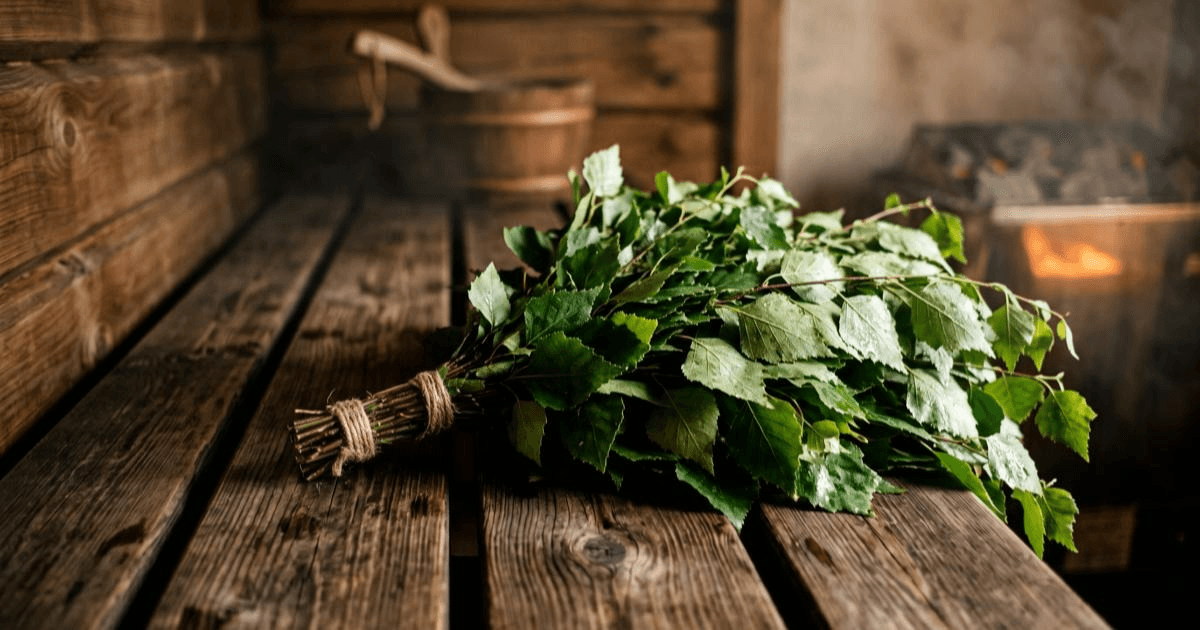
Vihta ritual
How to make a vihta: gathering, tying, and drying a birch whisk
Make your own vihta: when to gather birch, how to tie it, and how to dry or freeze the whisk so it lasts a full season.
Suoraan asiaan (straight to it)
Bottom line: Gather leafy birch around Midsummer, tie the stripped stem ends into a tight handle, then air-dry in shade or freeze the whisk fresh. A well-made vihta lasts a full season.
Key facts:
- Best gathering window: June to July around Midsummer, when leaves are soft and fully open
- Use silver birch for a stiff whisk; the finger test tells it from downy birch
- Bind the handle with a year-old willow or birch withe, about 80 cm long
- Freeze fresh in a squeezed, sealed bag; a frozen whisk keeps for years and packs flat
- A dried whisk revives in about 1.5 to 2 hours of warm water before your session
A vihta (birch whisk used to gently strike the body in the sauna) turns a plain hot room into a full sensory ritual. Making one is simple work. But the details decide whether it lasts a single evening or a whole season. This guide covers the making side only. It walks through when to gather birch, which tree to cut, how to tie a proper handle, and how to store the whisk so it keeps.
The same tool has two names. Western Finland calls it a vihta; eastern Finland calls it a vasta (the Eastern-Finnish name for the same birch whisk). The words are used interchangeably, and the making method is the same either way.
When to gather birch: the Midsummer window
The traditional gathering season is early summer, roughly June into July. It centers on Midsummer week, the Juhannus (the Finnish Midsummer festival) holiday. The timing is not just custom. It tracks the leaf itself.
By late June, birch leaves are fully open but still soft and pliable. They carry their peak load of fragrant oils. So a fresh whisk smells green and resinous when steam hits it. Cut earlier and the leaves are too small to fan out. Wait until late summer and they turn tough and leathery. Late leaves feel harsher on the skin and give off a weaker scent. A short window in the middle gives you soft, aromatic, well-sized leaves all at once. That biology is the real reason the ritual sits where it does on the calendar.
Gather on a dry morning if you can. Cool, dry branches keep their leaves better than warm, damp ones, and they are easier to sort. Bring more than you think you need. A single full whisk takes a good armful of shoots, and you will discard the weakest ones as you build.
One legal point matters before you pick up a knife. Cutting live birch branches is outside Finland's everyman's rights, the customary freedom to roam and forage. That freedom covers berries and mushrooms, not live wood. Live wood belongs to the landowner. So you need permission before you cut. On your own land you are free. Anywhere else, ask first. The same courtesy applies wherever you gather: take a few branches from several trees rather than stripping one.
Which birch to cut, and the finger test
Two species dominate: rauduskoivu (silver birch, or Betula pendula) and hieskoivu (downy birch, or Betula pubescens). Silver birch is the whisk-maker's default. Its branches are stiffer, so the whisk holds a firmer shape and lasts longer. Downy birch is softer and often smells sweeter. It also sheds sooner. Many makers cut mostly silver birch and add a few downy sprigs for aroma.
The two look alike from a distance, and they hybridize. Trust your fingers over your eyes. Draw a thumb along a young twig. Silver birch feels rough and warty, with small hard bumps and no hair. Its leaves are triangular, with a doubly toothed edge. Downy birch feels soft and slightly hairy. Its leaves are rounder, with a single row of teeth. Rough and warty means the stiff, long-lasting whisk. Soft and hairy means the fragrant one that drops leaves faster.
Within either species, choose the right branches. Pick supple shoots about half a meter (20 in) long that stay leafy right to the tip. Avoid the thin, whippy branches from the very top of the tree, since they carry too few leaves to fill out the fan. Skip any twig carrying catkins, the dangling seed clusters that shed and make a mess. Never cut wet branches or bind in the rain. Trapped moisture rots the bundle from the inside. The Finnish quality bar for a good whisk is easy to remember. No catkins, no thin treetop shoots, and no wet wood. A whisk is also at its best used fresh, within a couple of days of cutting. Hold to those four points and you avoid most of what ruins a homemade whisk.
How to tie the vihta
Start by sorting your branches. Lay the largest, leafiest shoots in the center. Arrange smaller ones around them, so the head builds into a round, even fan. As you add branches, keep adding to the top of the pile rather than the bottom. This keeps the head flat and stops it curling to one side. Turn the whole bundle over about halfway through to even out the shape. Turn each branch so its paler leaf-backs face outward. That pale side is smoother. It makes the finished whisk gentler on skin.
Strip the leaves and side-shoots from the bottom of each branch, about a hand's width up. This forms a clean handle. Leaving leaves on the handle is the most common beginner mistake. As those buried leaves dry and shrink, they loosen the whole bind. Then the whisk falls apart. A bare handle stays tight.
Now the bind. The cleanest tie uses a sidos (a thin binding withe). Traditionally this is a year-old willow or birch shoot about 80 cm (31 in) long. Gather it off-season, from autumn to spring, and strip off its side-shoots. A withe cut a year ahead is supple and unlikely to crack. Willow is the most forgiving because it bends without snapping. To use a birch withe, sharpen one end with a knife, then thread it through the handle. Wrap it firmly twice around the stripped handle and pull it tight. Then lock the sharpened end back under the wraps so nothing slips. In the east, where the same tool is called a vasta, makers often twist a birch band instead of threading a withe. Either works, and both hold better than a knot. If you have no withe on hand, strong natural twine holds a bundle well enough. Wrap the twine several times and tie it off snug. Trim the very bottom of the handle flat so it sits neatly in your palm.
Drying, freezing, and storing so it lasts
A fresh whisk is best used within about two days. To keep one past that, you have two paths: dry it or freeze it. They are not equal, and the difference shows up the first time you use each one.
Freezing is the stronger method. Squeeze the air out of a sealed plastic bag around a fresh whisk. Pack it flat, and put it in the freezer. Stored this way, a whisk keeps for years and takes almost no space. It can even go back in the freezer after one use if you reseal the bag. In a side-by-side test, a frozen whisk shed only about five leaves on its first use.
Drying is the older approach and still works, but a dried whisk degrades faster. One dried whisk in the same test lost nearly a quarter of its weight in a single session. If you dry, hang the whisk in a cool, dark, well-ventilated place. Hang it base-up so the handle drains and the head keeps its fan. Skip direct sun, which is the second-most-common mistake after handle leaves. Sun bleaches the leaves and makes them brittle. They then crumble the moment steam hits them. Shade and airflow over one to two weeks give you a whisk that survives handling. Some makers layer whisks with a little salt in a box to pull moisture out and hold color.
| Storage method | Longevity | Reviving before use |
|---|---|---|
| Frozen fresh | Years | About 30 min at room temperature, or under a minute in cold water |
| Air-dried in shade | One season | About 1.5–2 hours soaking in warm water |
Reviving and troubleshooting
How you wake the whisk depends on how you stored it. Thaw a frozen whisk for about half an hour at room temperature. Or drop it in cold water for under a minute. It needs no long soak, so it goes into the sauna springy and fresh. A dried whisk is different. It needs a real soak, about 1.5 to 2 hours in warm water, to soften the leaves before use. Rushing a dried whisk leaves it stiff and quick to shed.
Leaf shedding is the problem everyone hits. It almost always traces to one of three causes. Leaves left on the handle loosen the bind as they shrink, so strip the handle fully. Sun-drying makes leaves brittle, so keep the whisk in the shade while it dries. Over-soaking a frozen whisk waterlogs it. Treat frozen and dried whisks differently rather than soaking both for hours. A little shedding is normal even with a good whisk, especially from downy birch. Heavy shedding on the first use points to one of those three mistakes. Fix the cause, and the whisk holds together through a full session and beyond.
A good whisk rewards a little care up front. Gather at the right time from the right tree. Pick supple branches, tie a clean bare handle, and store the whisk cold or in shade. Do that, and one summer afternoon of work carries your löyly (the burst of steam from water on hot stones) sessions through the whole year.
Sources
- Quality guidelines for sauna whisks — Finnish Sauna Society
- Hyvien löylyjen salaisuus 2.0 — Lassi A. Liikkanen, 2022
- Saunavastan valmistus, varastointi ja käyttövinkit — Lassi A. Liikkanen, 2018
- Testi: talvivihdat kuivana vai pakkasesta? — Lassi A. Liikkanen, 2024
- Downy birch (Betula pubescens) identification — Woodland Trust
- How to make a Finnish sauna whisk — Helo