Lighting
IP68 sauna LED strip lighting: a high-temperature installation guide
How to install IP68 LED strip lighting in a sauna: temperature limits, cool-zone placement, waterproofing, and safe low-voltage wiring.
Suoraan asiaan (straight to it)
Bottom line: IP68 LED strip works in a sauna, but only in the cool zone below the top bench, never near the heater. Run 12 V or 24 V low voltage with the transformer outside the hot room, and leave the mains side to a licensed electrician.
Key facts:
- IP68 rates ingress only: fully dust-tight plus submersible to a depth the maker states
- IP is not a heat rating; check the separate operating-temperature spec on the datasheet
- Generic room strips run to about 40–60 °C; purpose-built sauna strips reach 90–110 °C
- Mount below the top bench, under bench lips or backrests, away from the kiuas
- Use 12/24 V DC; keep the transformer outside the hot room, mains side by a pro
A strip of LED light hidden under the top bench is one of the cheapest upgrades that changes how a sauna feels. Done right, it throws a soft glow up the wall and lets you skip the harsh overhead fixture. Done wrong, the strip cooks, the seal fails, and you are back to a dead run of tape in a matter of months. The difference comes down to two specs the marketing rarely separates: the waterproof rating and the heat rating. Get both right and pick the right spot, and the strip disappears into the woodwork and just glows.
What IP68 actually rates — and what it doesn't
IP68 is an ingress-protection code, and it describes two things only. The first digit, 6, means the strip is fully dust-tight: no dust gets in, and there is no contact with the live parts inside. The second digit, 8, means the sealed body resists continuous submersion in water. That is a stronger seal than the splash-and-spray strips sold for kitchens and bathrooms. It matters in a room built around steam, sweat, and the occasional bucket of water hitting the floor.
The catch is that the 8 does not fix a single depth. The maker sets the depth and duration the rating is tested to. One IP68 product might be certified for a meter for half an hour, and another for far more. For a sauna, the exact depth is beside the point. What you want is the sealed jacket that keeps humidity out of the diodes and solder joints over years of heat-and-cool cycling. A sauna cycles from cold to hot and back every session, and that is what pumps damp air in and out of an unsealed strip. Read the stated conditions anyway, because the code alone is a floor, not a full spec.
Here is the trap that sinks most first installs: IP68 is not a temperature rating. It says nothing about how hot the strip can run. A strip can be perfectly submersible and still fail in a warm room, because heat resistance lives in a completely separate line on the datasheet. Treat the two numbers as two different questions, and check both before you buy.
Heat is the real limit, not water
Most LED strip on the market is built for rooms people live in. A generic strip is typically rated for ambient temperatures around 40–60 °C (104–140 °F). Above that, the adhesive lets go, the diodes dim, and the lifespan collapses. A Finnish sauna does not stay anywhere near that. The air at bench height sits warm, and up near the ceiling, where the heater drives it, it reaches 90–110 °C (194–230 °F). That is the temperature the light has to be planned around.
Purpose-built sauna strips are a different product. Their datasheets carry high-temperature ratings that generic strips never approach. One common spec runs from -30 to 90 °C, another from -25 to 100 °C, with a neon-flex variant pushing to 105 °C. These use high-temperature diodes and a heat-tolerant silicone jacket rather than the plastics on a commodity reel. That construction is why the numbers hold up in a hot room. So the honest rule is not "LED strips die at 60 °C." It is that even a strip rated to 90 or 100 °C sits right at the edge of the hot-zone air. The cheap strips are nowhere close, and the good ones still have no headroom near the ceiling.
That single fact drives the whole install. The hottest air in the room meets or beats the rating of even the best strip, so the strip has to live where the air is coolest. Everything below comes down to keeping the light out of that top layer of heat.
Put the light in the cool zone, below the bench
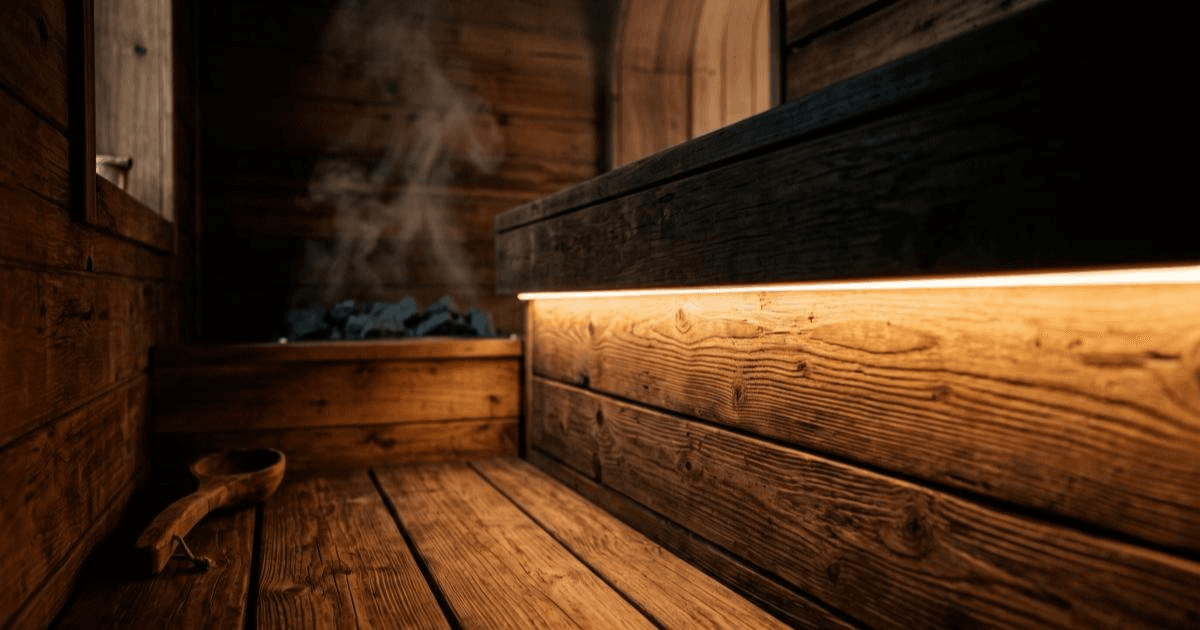
Heat stratifies hard in a sauna. The band from the top bench to the ceiling is the hot zone, and it is exactly where you must not run a light strip. Air near the floor can sit dozens of degrees cooler than the air at your shoulders. Mount the strip low instead, in the cool zone. Good spots are under the lip of the top bench, along the front edge of the lower bench, behind a backrest, or around the floor perimeter. These put warm indirect light into the room while keeping the diodes in the survivable band of air.
Under-bench mounting also solves glare. A strip tucked beneath a bench lip is invisible when seated, so you see the glow and not the diodes. A warm color temperature around 2700–3000 K suits the mood better than a cold white, which reads clinical in a wood-lined room. The one place a strip never belongs is on the ceiling near the kiuas (sauna stove). That is the single hottest surface-and-air combination in the room, and no strip rating survives it for long.
- Under the top-bench lip: the classic spot for a soft wall-wash
- Front edge of the lower bench: lights the step and the floor
- Behind a removable backrest: hidden, easy to service
- Floor perimeter: gentle wayfinding glow in a dark cabin
- Never on or near the ceiling, and never above the heater
If you want light higher in the room, that is the case for a different technology. Fiber-optic sauna lighting keeps its only heat-sensitive part, the illuminator, entirely outside the hot room. It feeds passive glass or plastic fibers into the ceiling, so it tolerates positions an LED strip cannot.
Wire it low-voltage, and know where the pro takes over
Sauna LED strip runs on low-voltage direct current, 12 V or 24 V, fed by a transformer, sometimes called a driver, that steps mains power down. That transformer is not rated for sauna heat and must sit outside the hot room. Put it in the changing room, a nearby dry cabinet, or a service void. Only the sealed low-voltage strip and its wiring enter the sauna itself. This split is the whole safety logic: heat-sensitive electronics stay in the dry, cool space, and the hot room sees nothing but a waterproof strip.
The low-voltage side is genuinely DIY-friendly. Wiring a 24 V strip to a driver carries no shock hazard. Mounting the strip, routing the cable through a gland, and plugging into the transformer are jobs a careful owner can do. Keep every connection waterproof and strain-relieved. Then mind two limits from the datasheets. First, a sealed strip has a maximum run length before voltage drop dims the far end, often around 10 m (33 ft). Second, cutting the strip usually forfeits the IP68 seal at the cut, because the factory end caps are what make it watertight. Buy the length you need rather than trimming a sealed reel.
The mains side is where the line is drawn. Getting power to the transformer, and protecting and disconnecting that circuit, is licensed-electrician work. Sauna lighting typically sits on its own circuit, separate from the heater, which makes ground-fault protection practical without the nuisance tripping a heater can cause. Keeping the two circuits independent also means the light stays under a simple wall switch or dimmer rather than being tangled into whatever smart sauna controller runs the heater. The Finnish electrical code, like wet-location wiring rules elsewhere, wants a disconnect in a dry spot and proper grounding on any sauna circuit. Have a licensed electrician handle everything upstream of the transformer, and confirm local requirements with them.
Choose the jacket that survives the steam
Two strips can both read IP68 and age completely differently, because the sealing method matters. A full silicone extrusion — the strip sits inside a molded silicone sleeve — is the durable route. Silicone stays flexible and shrugs off UV and yellowing. It survives the repeated expand-and-contract of a room that swings from cold to 90 °C and back every session.
Epoxy or resin potting is the cheaper method, and it does not hold up as well. Epoxy cures hard and brittle, and it yellows over time. It generally tops out around IP65 to IP67, with a comfort window closer to 0–60 °C — below what a sauna demands. Under thermal cycling and steam, a brittle jacket cracks and lets moisture reach the diodes. Once water gets to the solder joints, the strip is finished.
One counterintuitive detail: a thick jacket traps the strip's own heat against the diodes, which shortens their life in an already warm room. The fix is an aluminum channel behind the strip to pull heat away. It doubles as a clean mounting surface, and that matters because factory adhesive is a weak point. Even good 3M-grade tape is only rated for intermittent use to about 93 °C. So purpose-built installs use mounting clips or a channel rather than trusting tape in the heat. Pick a silicone-jacketed strip with a high-temperature diode rating. Seat it in an aluminum channel below the bench, keep the transformer cool and dry, and the light will outlast several sets of stones.
Get the two ratings straight and the rest is easy. You want IP68 for the seal and a real 90–110 °C spec for the heat. Then cool-zone placement makes sure the room never asks the strip to survive more than it was built for.
Sources
- IP68 Waterproof Rating (IEC 60529 IP Code explained) — Polycase
- IP Ratings Explained: IP65, IP66, IP67, IP68 Guide — indEx Enclosures
- IP68 High Temp, Submersible LED Strips (Sauna Rated) datasheet — LEDSupply
- Sauna LED Strip - Withstands 100 C, Heat Resistant & Waterproof — LEDYi Lighting
- How to Run Electricity to an Outdoor Sauna: Wiring, Code & Costs — Haven of Heat
- Building a sauna: electrical tips so you won't get fried — SaunaTimes
- IP67 vs IP68 LED Strip: Waterproof Rating Guide (silicone extrusion vs epoxy) — NPHIS LED