Science & physics
Löyly physics: water on hot stones, enthalpy, and steam quality
How a ladleful of water vaporizing on hot sauna stones turns 50 g per throw into the burst of steam Finns call löyly — the physics of good steam.
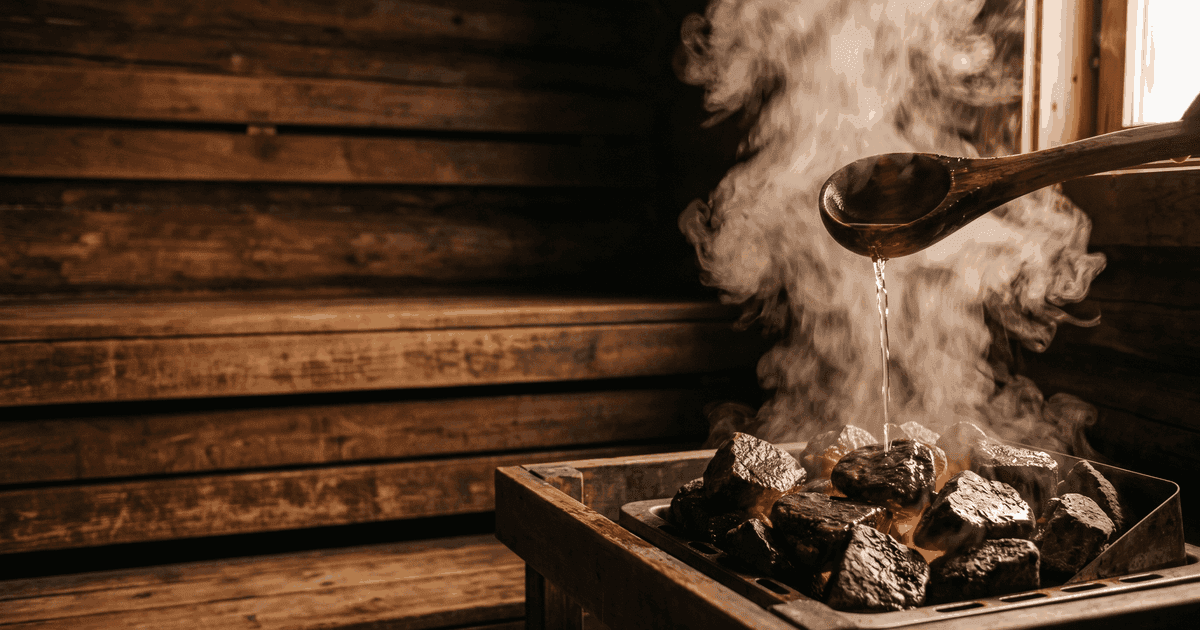
Pour a ladle of water on hot sauna stones and the room changes in about two seconds. The water hisses, flashes to steam, and a soft wave of heat rolls down from the ceiling onto your shoulders. Finns call that wave löyly (the burst of steam from water poured on hot sauna stones). The physics behind it is surprisingly tidy: a small mass of water, a large slug of energy, and a stone bed that quietly pays the bill.
What actually happens when water hits a 350 °C stone
A hot sauna stone is a thermal battery. During a session, the top surface stones in an electric kiuas (sauna heater) sit around 200–300 °C. The core of the stone bed runs hotter, typically 250–400 °C in steady use. The air in the room is much cooler. A Finnish sauna runs near 80 °C (176 °F), and bathers breathe air that holds only modest amounts of water vapor.
When liquid water lands on a stone that hot, it does not just warm up and evaporate slowly. It flash-boils. A thin film of vapor forms instantly under each droplet, and the droplet skitters across the stone while it changes phase. The energy needed to make that phase change is enormous compared with the energy needed to warm the same water. And the stones, not the air, supply it.
What the bather sees a moment later is hot, nearly saturated steam mixing into a much cooler room. The steam rises, hits the ceiling, and rolls back down. That rolling wave is the löyly. Everything that follows is about one question: where does the energy in that wave come from, and how much can you pull out per throw?
Enthalpy of vaporization — the number behind the burst
The number to know is the latent heat of vaporization of water at the boiling point. At 100 °C and normal atmospheric pressure, turning one kilogram of liquid water into one kilogram of steam costs about 2,257 kJ. That figure shows up across university physics tables. Some sources round it to 2,256 kJ/kg, others to 2,260, but the value is essentially fixed. For comparison, warming that same kilogram of water from 20 °C to 100 °C costs only about 335 kJ — roughly one-seventh as much.
Now scale it down to one throw. A Finnish home-sauna kauha holds around 50 g of water. Vaporizing 50 g at the boiling point therefore costs about 113 kJ. That is the energy budget of a single, clean löyly. It is not a small number. A 1 kW electric kettle would need almost two minutes of continuous boiling to deliver the same energy. The stones deliver it in seconds.
This is also why oversized throws produce wet droplets instead of steam. If a bather slings 200 g of water across cool surface stones, the bed cannot supply 450 kJ of phase-change energy fast enough. Some of the water flashes; the rest skids onto the floor or sprays as fine droplets that condense on skin a second later. The room feels heavy rather than hot. The physics has a name for this failure mode — running out of sensible heat at the boundary — but bathers know it by feel.
Stone mass, heat capacity, and why kilograms matter
The stones are doing the real work, so their numbers are worth a look. Olivine, peridotite, and olivinediabase are the standard Finnish heater stones. Their specific heat capacity sits near 0.84 kJ/kg·K. In plain terms, one kilogram of stone gives up about 0.84 kJ for every degree Celsius it cools. That is modest per kilogram. The trick is that a residential heater carries 40 to 100 kilograms of stone, and a large continuous-use kiuas carries well over that.
Do the arithmetic. A 100 kg stone bed that cools by 1.5 °C liberates about 126 kJ of sensible heat. That is enough to vaporize one 50 g throw cleanly, with a small margin to spare. A 50 kg bed cooling by the same 1.5 °C only liberates 63 kJ. That is not enough for a clean throw, so the stones must dip further in temperature, or the throw must be smaller. This is the physical reason Finnish guidance treats roughly 15 kg of stones per cubic meter of sauna volume as a working minimum.
The same logic explains the difference in feel between heater styles. A thin-walled basket heater exposes a smaller, lighter stone load to the room. It heats fast, but it also cools fast between throws and recovers slowly. A tall cylindrical heater with a deep stone column carries more mass. It runs a wider temperature gradient from top to bottom, so the bottom stones stay hot longer. The top stones, where the water actually hits, can be refreshed by conduction from below while the bather waits a couple of minutes between throws.
Stone choice matters for the same reason. Igneous rocks like olivine, peridotite, and basalt survive thermal cycling. Red granite, sedimentary stones, and metamorphic rocks crack and crumble. Lost mass means falling steam quality over time.
Good löyly vs bad löyly — the saturation curve
Air at 80 °C can hold a remarkable amount of water vapor before it saturates. Push past that limit, and the excess condenses out — onto walls, onto the ceiling, and onto bathers. That condensation is what bad löyly actually is.
A clean throw briefly raises the relative humidity in the upper bench zone, where the steam pools just under the ceiling. Bathers feel a soft, even heat that fades over a minute as the room reabsorbs the moisture and the steam pocket dissipates. The droplets carried by good löyly are very fine — on the order of seven micrometers. That is small enough to stay airborne and ride the convective loop above the stones.
Bad löyly looks different at the same scale. Oversaturated air carries larger droplets. Those droplets fall, not rise. They land on skin already near 35 °C and condense further, releasing their phase-change energy directly onto the bather. The sensation is heavy, choking, and damp. The same thermometer reading can feel pleasant after one throw and unbearable after the next. What changed was how much liquid water ended up suspended in the air.
| Good löyly | Bad löyly | |
|---|---|---|
| Droplet size | ~7 µm, airborne | larger, falling |
| Air state | below saturation | above saturation |
| Sensation | soft warm wave | heavy, damp, choking |
| Recovery | ~60 s | several minutes |
Technique, in other words, is not separate from the physics. It is the physics. The bather chooses the water mass, the timing, and the placement on the stones. The stones supply the energy budget. The room handles the rest.
The 50 g per throw heuristic, in physics terms
Finnish sauna tradition has converged on roughly 50 g of water per throw, with a couple of minutes between throws. The number is not arbitrary. It is the throw size that matches the energy a typical residential stone bed can deliver in a single hiss. The stones can do it without dipping below the temperature needed to flash the next throw cleanly. Smaller throws on hotter stones produce better steam than bigger throws on cooler stones. Two 50 g throws spaced a minute apart almost always feel better than one 100 g throw.
The word itself carries some of this discipline. The Finnish etymological dictionary traces löyly to an inherited Finno-Ugric root meaning breath, spirit, or soul. Cognates run through Estonian and as far as Hungarian, where the related word lélek still means soul. The semantic narrowing from breath to sauna steam is a uniquely Finnish development. The vocabulary is ancient. The physics is recent. The bather sitting on the top bench is using both at once.
A short note on conditions: the 2,257 kJ/kg latent-heat figure assumes water boiling at sea level. At altitude the value shifts slightly upward as the boiling point drops. The change is small enough that it does not move the practical heuristic. This is a physics-only explainer. None of the numbers here are medical claims, and stone-temperature ranges describe typical operating behavior rather than any code or clearance.
Respect the stones' energy budget and the steam quality follows. That is the whole law of löyly, written in joules.
Sources
- Hyvien löylyjen salaisuus 2.0 — Saunan muotoilu ja suunnittelu — Lassi A. Liikkanen, 2022
- 14.3 Phase Change and Latent Heat — College Physics 2e — OpenStax, 2022
- Löyly — Suomen etymologinen sanakirja — Kotus (Institute for the Languages of Finland)
- Bare facts of the sauna in Finland — Mikko Norros (thisisFINLAND)
- Finnish Sauna Essentials Part 3 — Heat makes the Finnish sauna and the stove makes the heat — Lassi A. Liikkanen
- Finnish Sauna Essentials Part 4 — sauna stove and stone selection, basic use — Lassi A. Liikkanen
- Why sauna designers should care about the Law of Löyly — Walker Angell (Saunologia), 2025
- The Science of Sauna Thermodynamics — How Heat & Steam Really Work — Haven of Heat (Kelly), 2025
- What You Need to Know About Sauna Rocks — Glenn Auerbach (SaunaTimes), 2012
- Enthalpy of vaporization — Wikipedia contributors