Cleaning
Sauna floor and drain cleaning: a biweekly to annual playbook
Clean your sauna floor and drain on a cadence: after every session, biweekly, monthly, quarterly, annual. Fixes drain odor and protects the boards.
Suoraan asiaan (straight to it)
Bottom line: Rinse the floor after every session, deep-wash it every two weeks, flush the drain monthly, and refresh the floor seal every 12–24 months. Stick to pH-neutral or enzymatic cleaners on hot-surface materials, and never mix sauna cleaner with chlorine.
Key facts:
- Quick rinse and squeegee after every session — water goes into the trap, not on the boards.
- Pour 1 L of near-boiling water plus an enzymatic cleaner down the drain once a month.
- Run a 60–90 cm drain rod through the trap quarterly to break up hair and lint.
- Refresh sauna-grade floor wax (Tikkurila Supi class) every 12–24 months.
- Wash anti-slip mats weekly at 40 °C; replace at 18–24 months when the grip dulls.
Most sauna-cleaning advice treats the floor as a one-line footnote and never opens the drain at all. That is exactly how a clean-looking sauna ends up smelling sour by month three. The fix is a cadence: a 60-second reset after every session, a deep wash every two weeks, a drain flush monthly, and a hardware check quarterly. A seal refresh closes the year.
After every session: the 60-second floor reset
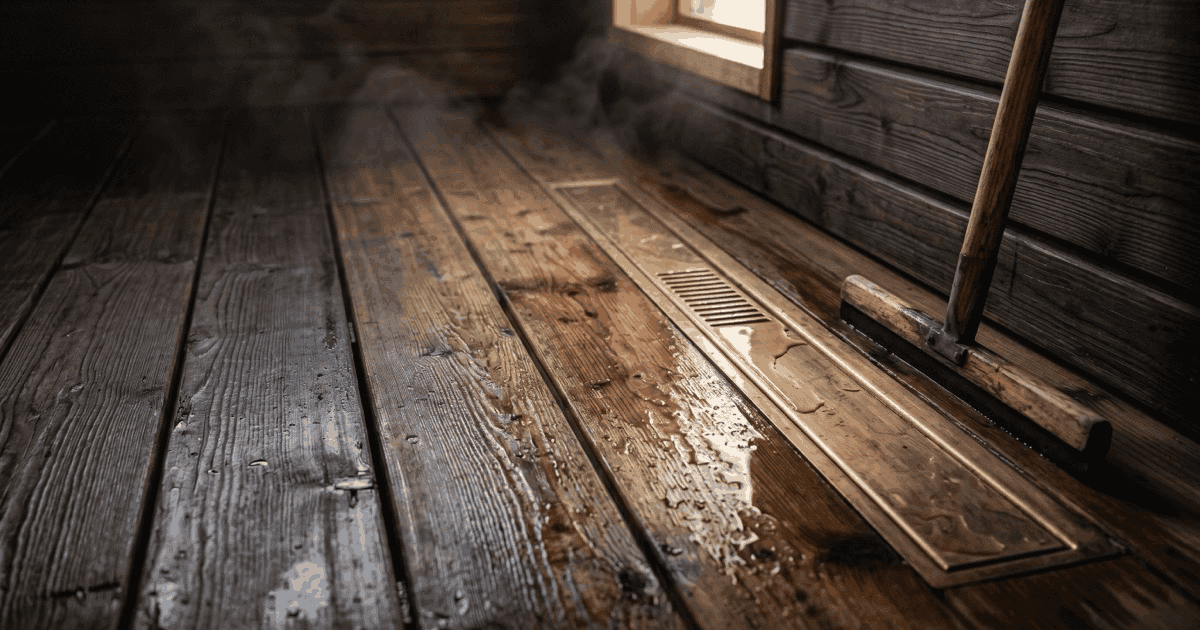
The single most useful habit is also the cheapest. Before the room cools, sluice a bucket of warm water across the floor, sweep it toward the drain with a squeegee, and walk out. That is the whole routine. The point is not to wash. It is to move the night's sweat, foot grit, and stray löyly (the burst of steam from water poured on hot stones) splash off the boards. The wood is still warm enough to evaporate the rest in under half an hour.
The second point is to feed the drain. A floor that ends every session with a cup of water disappearing down the trap will not develop dry-trap odor. That sour note shows up after a long unused week. Skip the rinse and the trap can go dry in a couple of weeks, especially in a heated bathroom where evaporation is fast.
Never pull out chlorine-based wipes, bleach sprays, or generic bathroom cleaner for this step. Household cleaning chemicals react differently when they hit hot wood, and the residue gets baked into the porous boards. Plain warm water is the right tool for the daily reset.
Biweekly and monthly: the deep wash and drain flush
Every second week, give the floor a proper wash. Pour warm water mixed with a sauna-grade cleaner. Tikkurila Supi Saunapesu is the canonical Nordic option. A traditional pine-soap such as Vaasan Aito Saippua works for the bench-and-floor wipe at the same time. Scrub with a soft brush along the grain, never across it, then rinse twice: once warm to lift the cleaner, once cool to close the wood. A wet-vac or squeegee finishes the floor in a minute. Avoid the pressure washer entirely — the pressure shreds the soft-wood surface and forces water under any seal you have.
Once a month, flush the drain. The recipe is one liter of near-boiling water poured slowly, followed by an enzymatic floor or drain cleaner — the kind sold for kitchen sinks works well. Enzymes break down the biofilm that builds up on the trap walls in any drain that sees soap, hair, and warm water on a schedule. A bleach pour is a tempting shortcut, but biofilm regrows to its previous density within a day or two. The chlorine itself also eats the rubber trap seals over time.
The order matters: hot water first to soften the slime, enzyme second to digest it, and then a final warm rinse 20 minutes later. Done monthly, the flush keeps drain odor at zero for the entire year.
Why your sauna drain smells (and how to fix it for good)
When a sauna drain starts venting a sewer-gas note, four causes account for almost every case. Work the list from most to least common.
- Dry P-trap. The trap is the U-shaped section of pipe below the floor drain. The water sitting in the U is the only thing keeping sewer gas from rising into the room. If the sauna sat unused for a few weeks, the trap evaporates and the smell shows up overnight. The same happens when the bathroom next door dries it out by ventilation. Fix: pour a liter of water down the drain. Smell gone within an hour. Add a tablespoon of mineral oil on top of the water to slow future evaporation.
- Biofilm coating the trap walls. A faint, persistent, soapy-rotten note that does not respond to a single water pour means the slime is colonizing the trap above the waterline. Fix: the monthly enzymatic flush above. Run it for two months in a row to reset a neglected drain.
- Hair and lint plug. A gurgle, slow drainage, and a stale smell together point to a physical clog at the trap inlet. Fix: a 60–90 cm flexible drain rod or hair-snake, fed into the drain and twisted out. Two minutes. Follow with the enzymatic flush.
- Frozen trap (cold-climate basements only). Sudden onset in January, dry drain that refuses water, sometimes a stink that fluctuates with outside temperature. Fix: warm the trap with a heat lamp or a slow trickle of warm water until the ice clears, then insulate the pipe run upstream.
If the room is well ventilated and the floor dries between sessions, you will almost never see anything past the first item.
Quarterly: drain rod, mat refresh, grout check
Every three months, do three small jobs that nothing else on the calendar catches.
First, run the drain rod even if the drain is behaving. Two minutes of physical agitation pulls out the lint and hair that an enzymatic flush cannot dissolve. A 60–90 cm flexible plastic rod with a barbed tip is the right tool. It is long enough to reach the building waste stack on a typical sauna floor, and soft enough that it will not scratch a stainless trap.
Second, take the anti-slip mat out into the daylight and look at it. EVA-foam and woven-plastic mats lose grip slowly; rubber mats lose it suddenly when the surface texture wears smooth. A weekly 40 °C laundry cycle (gentle setting, no fabric softener) keeps the surface clean and the grip intact. Plan to replace the mat at 18–24 months of normal use. Replace sooner if it starts to slip on a wet floor — that is the point at which it stops being safe.
Third, run a finger along the tile grout around the drain channel if you have a tiled floor. Hairline cracks at the perimeter are the first sign that water is wicking under the floor instead of going down the drain. A bead of sanitary silicone at that joint costs less than a beer and prevents the slow leak that rots out a subfloor.
Annual: floor seal refresh and trap teardown
Once a year, two bigger jobs put the floor and drain back to factory condition.
The floor seal refresh keeps the boards waterproof and the grain visible. A sauna-grade wax such as Tikkurila Supi Saunavaha goes on with a brush or sponge in two thin coats. Allow about 24 hours of cure time before the room sees water again. Coverage runs roughly 10–13 m² per liter, so a 5 m² sauna floor uses well under half a tin. The refresh interval is 12–24 months in steady use. Lean toward 12 if you sauna four times a week, and 24 if it is a once-a-week ritual. The tell is the water-bead test: drip a teaspoon of water on the boards and watch. Beads that hold their shape for 30 seconds mean the seal is fine; water that flattens and soaks in inside 10 seconds means it is time. Strip the floor with Supi Saunapesu first, let it dry overnight, then wax.
The trap teardown is the once-a-year job that prevents the next twelve months of small problems. Unscrew the drain grate, pull the strainer basket if your trap has one, and lift any removable trap insert. Clean each piece in a sink with hot water and dish detergent. A bottle brush takes care of the trap walls. Inspect the rubber seal at the trap-to-pipe joint; replace it if it is cracked or compressed flat. Reassemble, refill the trap with clean water, and the drain is reset to year one.
Done on this schedule, the floor and drain disappear from the maintenance list — the way a sauna is supposed to feel.
Sources
- Supi Saunavaha — product page — Tikkurila, 2026
- Supi Saunapesu — product page — Tikkurila, 2026
- Tips for cleaning and maintaining your sauna — Finnleo
- The basics of sauna maintenance — HUUM, 2025
- Designing a great wooden sauna floor — drainage and airflow explained — Lassi A. Liikkanen, 2026
- Does a sauna need a drain? The complete guide — Haven of Heat, 2025
- Biofilm in building drains: why it forms and why it persists — Green Drain, 2026
- Sauna cleaning — natural cleaning products and recipes from the Finnish granny — Tiina, 2024