Sizing & dimensions
Sauna room dimensions: minimum, recommended, and generous footprints
How much space do you need for a sauna? Minimum, recommended, and generous room dimensions in meters and feet, with ceiling height and volume rules.
Suoraan asiaan (straight to it)
Bottom line: Plan a home sauna around three room-size tiers. The minimum sits near 1.5 m² for one bather. The recommended is 4–6 m² for a family of four. The generous is 7–9 m² when you want a reclining bench. Ceiling height stays 210–230 cm at every tier.
Key facts:
- Minimum sauna footprint: ~1.5 m² (16 ft²) for one upright bather, single bench
- Recommended family size: 4–6 m² (43–65 ft²) for three to four bathers, two tiers
- Generous footprint: 7–9 m² (75–97 ft²) for reclining bench and six bathers
- Ceiling height: 210–230 cm (6 ft 11 in to 7 ft 7 in) regardless of footprint tier
- Room volume sets heater size at roughly 1 kW per cubic meter of sauna
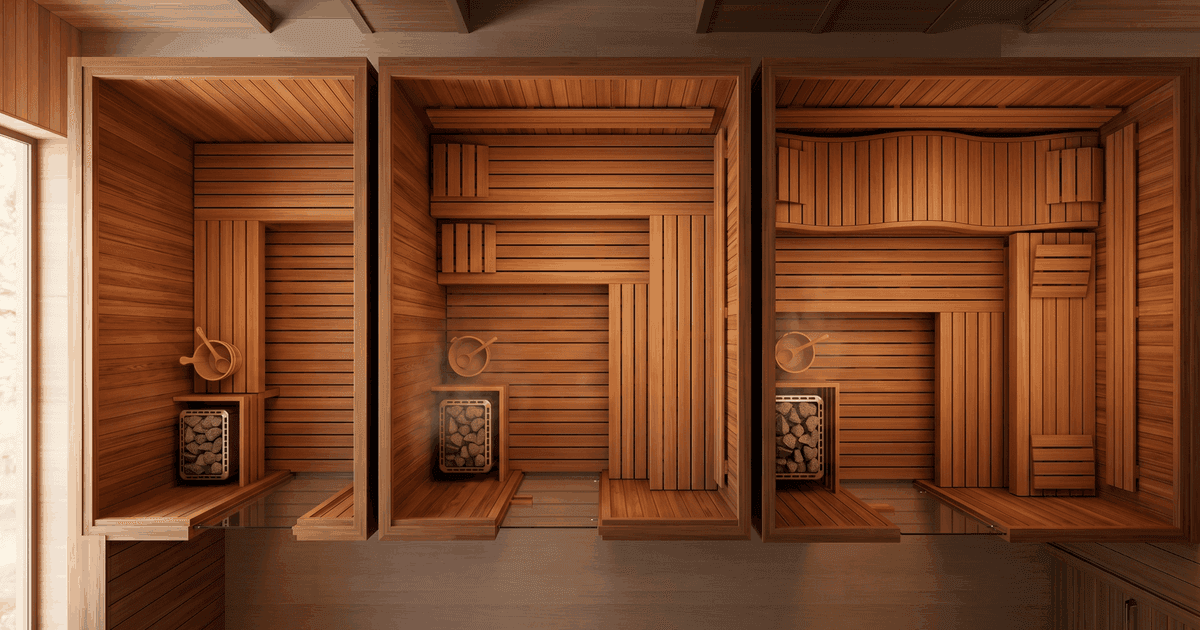
A home sauna fits inside three useful room-size tiers, and most prefab confusion clears up once you anchor to them. The minimum footprint is roughly 1.5 m² (16 ft²) for one upright bather. The recommended family size is 4–6 m² (43–65 ft²). The generous tier opens to 7–9 m² (75–97 ft²) when you want a reclining bench and six bathers seated.
The three sizing tiers — minimum, recommended, generous
Sauna sizing is not about how many bodies you can pack into a hot room. Each bather needs room to breathe, a comfortable bench, and enough volume for real löyly (steam from water poured on hot stones). Three tiers cover the home market.
The minimum tier sits near 1.5 m² (16 ft²). One upright bather, a single short bench, and a small heater. Think a 1.2 × 1.3 m (4 × 4 ft 3 in) interior. It works as a personal bath squeezed into a closet or a basement corner. It does not host guests, and it does not handle two adults side by side.
The recommended tier is 4–6 m² (43–65 ft²) and is where most home builds land. Plan on a 2 × 2 m room up to 2 × 3 m. That is 6 ft 7 in square at the small end, up to 6 ft 7 in × 9 ft 10 in at the large end. You get two bench tiers, three to four bathers seated, and a heater that pulls the room to 80 °C (176 °F) in about half an hour. The tier matches the Finnish sauna tradition of about 3 m³ (106 ft³) of room volume per bather. Comfort climbs toward 4 to 6 m³ (141 to 212 ft³) each as the room grows.
The generous tier runs 7–9 m² (75–97 ft²). Now you have room for a reclining bench along one wall, six bathers seated upright, or a four-bather group with elbow room for a vihta (birch whisk). At this footprint the room volume passes 15 m³ (530 ft³), and the heater steps up to a larger floor or tower model.
Ceiling height is the dimension that does not scale with floor area. Across all three tiers, plan on 210–230 cm (6 ft 11 in to 7 ft 7 in). Finnish sauna tradition treats the ceiling as the master dimension, because every bench tier hangs off it. The top seat needs to land 100–120 cm (39–47 in) below the ceiling. That puts bathers' heads inside the heat zone where löyly actually pools.
Width, depth, and ceiling height — why all three matter
A prefab brochure will quote you a single floor area and move on. That misses two-thirds of the story. Width, depth, and ceiling height each lock down something different, and you can't trade one for another past a certain point.
Width sets bench length. A single bather upright needs about 60 cm (24 in) of bench width. Two seated bathers want 120 cm (47 in), and the recommended-tier family of four runs an L-shaped bench that wraps a corner. Below 180 cm (5 ft 11 in) of interior width, the L-bench gets cramped and the top tier shortens to a perch.
Depth does two jobs. It carries the bench tiers and it holds the floor zone between heater and bench. The minimum tier loses depth fast: a 1.2 m (4 ft) deep room with a 60-cm bench and a wall-clearance heater leaves almost no standing space. The recommended tier wants at least 1.8–2.0 m (6 ft to 6 ft 7 in) of depth. That lets the top bench sit 60 cm (24 in) deep without crowding the wall.
Ceiling height is the dimension prefab cabins shortchange most often. The Finnish baseline is 210–230 cm (6 ft 11 in to 7 ft 7 in). Some builders push to 250 cm (8 ft 2 in) for a higher heat zone above the top bench. Drop below 210 cm and the top-bench-to-ceiling distance collapses below 100 cm — the bench feels lukewarm even when the heater is fully loaded. Push past 250 cm and the heater fights a column of cool air above the bathers, which costs warm-up time and stones.
The trap shows up at the minimum tier. A 1.5 m² (16 ft²) footprint with a 2.4 m (7 ft 10 in) ceiling produces worse löyly than the same footprint at 2.1 m. The bench-to-ceiling distance breaks the 100–120 cm rule. Small footprint plus tall ceiling sounds airy on paper and bathes poorly in practice.
Reference footprints and how they shape heater size and cost
The table below pairs each tier with a typical interior, a room volume, and the heater band the room will need. Volume is what the heater actually sizes against, not floor area.
| Tier | Floor area | Typical interior | Room volume | Heater band |
|---|---|---|---|---|
| Minimum | 1.5 m² (16 ft²) | 1.2 × 1.3 m (4 × 4 ft 3 in) | ~3.3 m³ (117 ft³) | 3–4.5 kW |
| Recommended | 4–6 m² (43–65 ft²) | 2 × 2 m up to 2 × 3 m | 9–13 m³ (318–459 ft³) | 6–9 kW |
| Generous | 7–9 m² (75–97 ft²) | 2.5 × 3 m up to 3 × 3 m | 15–20 m³ (530–706 ft³) | 9–12 kW |
A useful rule of thumb is about 1 kW of heater power per cubic meter (or roughly 35 ft³) of insulated room volume. Add roughly 1.2 m³ (42 ft³) of effective volume for every square meter of uninsulated stone, tile, or glass wall. A glass wall in particular drags a heater up one whole band.
Volume also pulls cost. The minimum tier runs on a small wall-mounted heater, a single bench, and short wall runs. The recommended tier doubles materials and steps the heater up into the band where premium Finnish brands like HUUM, Harvia, and Tylö live. The generous tier adds reclining bench framing, a tower-style heater such as a Cilindro, and usually a dedicated ventilation pickup. Costs roughly track the volume change: each tier is about twice the build cost of the one below it.
Ventilation scales with volume as well. The recommended-tier room wants around six air changes per hour, with an inlet near the heater base and an outlet just under the ceiling on the opposite wall. Skipping ventilation at this tier is the single most common reason a brand-new sauna feels stuffy in the second session of the evening.
Common dimension mistakes that shrink a sauna in practice
A stated footprint and a usable footprint are not the same number. Four small reductions stack up and turn a brochure 2 × 2 m room into something closer to 1.7 × 1.7 m by the time you sit down.
- Wall build-up. A code-quality sauna wall runs roughly 70–80 mm (about 3 in) per side of frame, vapor barrier, foil, batten, and panel. On a 2 × 2 m exterior, you lose 14–16 cm (about 6 in) of usable width and depth before the bench goes in.
- Heater clearance. Most wall-mounted heaters need 5–10 cm (2–4 in) clearance to wood at the back and sides. A floor or tower heater needs a 10–25 cm (4–10 in) safety perimeter. That perimeter often eats one full corner.
- Door swing. An inward-swinging door takes a roughly 70 × 70 cm (28 × 28 in) bite out of the floor zone every time it opens. An outward swing avoids this, but only if the room outside accepts the swing.
- Bench depth. The two-tier bench wants 60 cm (24 in) of top-bench depth and 40 cm (16 in) of step. A prefab that ships with a 45-cm (18 in) top bench is using shallow seating to pad its capacity claim.
The second mistake is more cultural than dimensional. Marketing copy that promises a four-person sauna in a 1.5 × 1.8 m (5 × 6 ft) box is selling four bathers in shallow seats with knees touching. Comfortable four-bather seating wants at least 4 m² (43 ft²) of floor area, an L-shaped bench, and the recommended-tier ceiling.
For a considering reader, the planning move is to pick a tier first and a brand second. If you are unsure which tier fits your household, walk through the bather-count math once. Count how many adults will sit at the same time on a busy evening. Add one if you want a reclining bench. Two-bather households almost always fit the recommended tier. Solo bathers can land at the minimum tier without compromise. The ceiling stays at 210 cm and the bench-to-ceiling rule still holds.
Nail the three dimensions — floor area, ceiling height, and room volume — and the rest of the sauna build snaps into place. Heater kW, ventilation flow, and bench geometry all key off those three numbers.
Sources
- Hyvien löylyjen salaisuus 2.0 (Secrets of Finnish Sauna Design) — Lassi A. Liikkanen, 2022
- RT 91-11257 — Sauna design (Saunan tilojen suunnittelu) — Rakennustieto, 2017
- How big should a Finnish sauna be? — Lassi A. Liikkanen, 2020
- Finnish Sauna Essentials Part 6 — Interior design — Lassi A. Liikkanen, 2018
- Sauna Bench Sizes and Specifications: The Complete Guide for 2026 — Finnmark Sauna, 2026
- How to design a sauna — Harvia, 2026
- Sauna Heater Size Calculator: How to Choose the Right Power Rating — HUUM, 2025
- Planning a Sauna Bench: Practical Tips and Ideas — HUUM, 2024
- Sauna Ceiling Height, Bench Height & the Finnish Rule of 230 — Haven of Heat, 2026