Smart upgrades
Smart heater retrofits: adding Wi-Fi to a heater you already own
Can you add smart Wi-Fi control to a sauna heater you already own? How contactor and separate-controller compatibility decides retrofit versus full swap.
Suoraan asiaan (straight to it)
Bottom line: You can add Wi-Fi to a sauna heater only if it runs on a separate wall-mounted controller. Swap that controller for a smart one. Heaters with a built-in dial thermostat usually cannot be retrofitted at all.
Key facts:
- Separate-controller heaters retrofit cleanly; built-in-dial heaters usually cannot
- A contactor carries the heating load; the smart controller only switches low current
- Two paths: an add-on Wi-Fi module, or a full controller swap (HUUM UKU, Harvia Xenio)
- Remote or scheduled start needs a door safety switch so the heater cannot start loaded
- All mains-side wiring and contactor work must be done by a licensed electrician
The single question that decides a smart-heater retrofit is not which app you want. It is how your kiuas (sauna stove or heater) is wired. Heaters that run on a separate wall-mounted controller can accept Wi-Fi control by swapping that controller. Heaters with a built-in dial thermostat usually cannot be made smart at all. Before you shop for a controller, find out which kind you own.
Which existing heaters can accept smart control
Electric sauna heaters fall into two wiring camps, and the split decides everything about a retrofit.
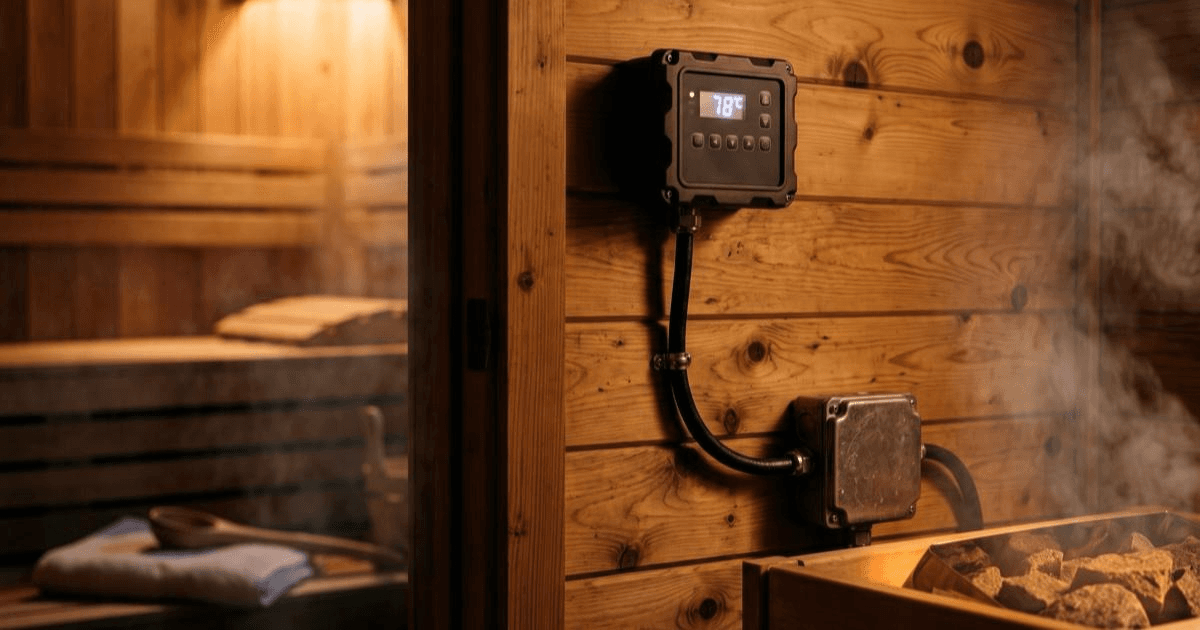
The first camp uses a separate controller. The heater is a plain box of elements and stones, and a wall-mounted panel outside the hot room sets the temperature and timer. The panel talks to the heater over a low-voltage sensor and control cable. This is the camp that retrofits. Because the controller is a distinct, replaceable unit, you can lift out the old one and drop in a smart equivalent that speaks the same wiring language.
The second camp puts the thermostat on the heater itself. These units have a knob or dial on the casing, and turning it up mechanically closes the circuit to the elements. There is no external control connection to swap, because the control lives inside the heater. A dial heater cannot become a smart heater in any meaningful sense. You could rig a relay to switch its power on and off remotely with the dial pinned at maximum. But you would lose all temperature regulation, which is the whole point of a smart controller in the first place. For a dial heater, the honest answer is a new heater plus a controller, not a retrofit. That is a bigger project and a bigger budget, and it is worth naming up front so you are not chasing a module that will never fit.
So the first step is a look, not a purchase. If the temperature control lives on a panel on the wall, you are likely in retrofit territory. If it lives on the heater as a knob, you are almost certainly not.
The contactor: the part that decides whether a retrofit works
A smart controller does not carry your heater's electricity. That job belongs to a component called the contactor, and understanding it clears up most retrofit confusion.
A sauna heater pulls serious current. A 9 kW unit pulls roughly 13 amps on each leg of a 400-volt three-phase supply, or close to 40 amps on a 240-volt single-phase feed. That is far more current than the delicate electronics of a Wi-Fi panel could ever handle. The contactor is a heavy-duty switch that sits in the power circuit and carries that full load. The controller only sends it a low-current signal that says on or off. When you set a temperature, the panel reads the room sensor and pulses the contactor; the contactor does the actual heavy switching.
The hardware makes this concrete. In one common separate-controller family, the power unit holds a 30 A contactor for the smaller model and a 45 A contactor for the larger one. The wall panel simply drives it. Another manufacturer's controller switches heaters up to about 10.5 kW directly. Anything larger needs an added contactor unit between the controller and the heater. In a fully modular Wi-Fi system, the contactor lives in a separate main module wired to the heater. The low-current panel and sensors plug into that module rather than into the heater directly.
The practical takeaway is short. A retrofit works when there is already a contactor in the circuit, or room to add one, and the new smart controller is designed to drive it. That is the norm for separate-controller heaters. It is the missing piece for dial heaters, where the switching is buried inside the casing with no clean point to tap.
Add-on module versus a full controller swap
Once you know you have a separate controller, two retrofit paths open up, and they cost very differently.
The cheaper path is an add-on Wi-Fi module. Say your existing controller is a modern digital unit from a brand that sells a matching bridge. A small module clips into the controller's data circuit and brings the app online without replacing the panel. Some systems also let a relay box sit between the controller and a Wi-Fi dongle to extend switching. This is the least invasive option. But it only exists where the manufacturer built for it, and the module has to match your exact controller model. A near-match from the same brand is not enough; the part number has to line up.
The more general path is a full controller swap. Here you remove the existing panel and power unit and install a Wi-Fi-capable controller in their place. Two well-documented examples show how this works:
- Harvia's Xenio Wi-Fi panel is built to replace an existing compatible Xenio power unit (the CX170, CX30, CX45, and Combi CX30C). An owner already on Harvia's heater platform swaps the panel and gains app scheduling and a week timer.
- HUUM's UKU Wi-Fi ships as a full set: panel, main module with the switching contactor, temperature sensor, and door sensor. It is rated for heaters up to 11 kW and works with almost any control-unit-equipped heater, not just one brand. HUUM's own heater lineup is built around this separate-controller design.
The rule of thumb: if a matching add-on module exists for your exact controller, that is the fast, cheap route. If it does not, a full swap to a smart controller that fits your heater's wiring is the reliable one. A swap also refreshes the sensor and safety hardware, which is worth having on an older install. Neither route helps a dial heater, because there is no separate controller to add to or replace.
When a retrofit is not possible or not safe
Some retrofits are simply off the table, and it is better to know before money is spent.
The clearest no is the built-in-dial heater with no external control connection. There is nothing to swap, and bypassing the dial to force remote on/off throws away temperature control and safety cut-offs. Kits also stumble when brands mix incompatible components. A Wi-Fi sauna controller from one maker often will not read another maker's sensor without the correct matching parts. A cross-brand retrofit can quietly fail on details like connector shape or sensor type.
The safety limit is firmer and non-negotiable. Any heater you can start remotely or on a schedule must be prevented from starting while something is resting on the stones or bench. Manufacturers solve this with a door safety switch, a bench sensor, or an equivalent cut-off wired into the controller. Finnish sauna heater safety guidance requires this interlock for remote or app-based operation. The heater cannot arm its remote-start state unless the door is closed and the safety circuit is intact. Narrow exceptions apply for running the heater from its own local panel or for a fixed delayed-start timer. A retrofit that adds remote start without this interlock is not a shortcut; it is a fire risk. If your smart controller offers remote or scheduled start, budget for the door switch as part of the job, not as an optional extra.
Heads up
Remote start turns a sauna heater into an appliance that can switch on with nobody in the room. Never enable app or scheduled start without a working door or safety interlock wired into the controller.
The electrician's side: mains wiring you cannot DIY
The smart part of a retrofit is the easy part. The wiring behind it is not homeowner work.
Everything on the load side carries full mains current on a high-amperage circuit. That includes the contactor, the heater feed, and the connection between the power unit and the heater's terminals. The Finnish electrical code, like codes across most of the world, requires this work to be done by a licensed electrician. Manufacturer manuals say the same in plain terms: the door-switch and power terminals may only be connected by a qualified electrician. The reason is not bureaucracy. A loose high-current terminal on a 40-amp sauna circuit is a fire and shock hazard. The safety interlocks only protect you if they are wired correctly.
A sensible division of labor looks like this. You decide which smart controller fits your heater and confirm the retrofit path — add-on module or full swap. You mount the wall panel and pair the app, which is genuinely plug-and-play once the wiring is done. The electrician handles the contactor, the mains feed, the heater connection, and the safety-switch circuit, then tests the whole thing under load. Treat the low-voltage panel as yours and the high-current side as theirs, and a retrofit stays both affordable and safe.
The short version: check the controller before you check the catalog. A separate wall-mounted panel means a retrofit is likely. A dial on the heater means it usually is not. Either way, the mains side belongs to a professional, and the door switch is not optional the moment you add remote start.
Sources
- UKU WiFi — sauna control system — HUUM
- Xenio WiFi remote control — control units — Harvia
- Safety devices for electric heaters — Harvia
- Xenio CX30 / CX45 installation and instruction manual (USA) — Harvia, 2024
- Vertailu: miten helppoa ja turvallista on kiukaan etäohjaus? — Lassi A. Liikkanen, 2021
- home.com4 — sauna control unit — Sentiotec