Smoke sauna
Smoke sauna: methodology, history, and why people still do it
What a savusauna is, the firing-and-venting rhythm, why Finnish and Estonian Võromaa bathers still build them, and the CO safety boundary.
A savusauna (smoke sauna) is not a flip of a switch. A wood fire burns under a pile of stones for hours. Smoke fills the room as it heats. Only after the embers are out and the room is fully vented does anyone step inside to bathe. The rhythm of load, burn, clear, and bathe is the whole point. It is also where the danger lives.
Most modern saunas hide the fire behind a chimney and a metal firebox. The savusauna does the opposite. It is the older form. Finnish farmsteads used it for centuries before chimneys became cheap. A quiet revival keeps it alive today in southeastern Estonia and at a handful of Finnish heritage cabins. To understand why anyone still builds one in 2026, walk through the methodology first and the romance second.
What makes a savusauna different
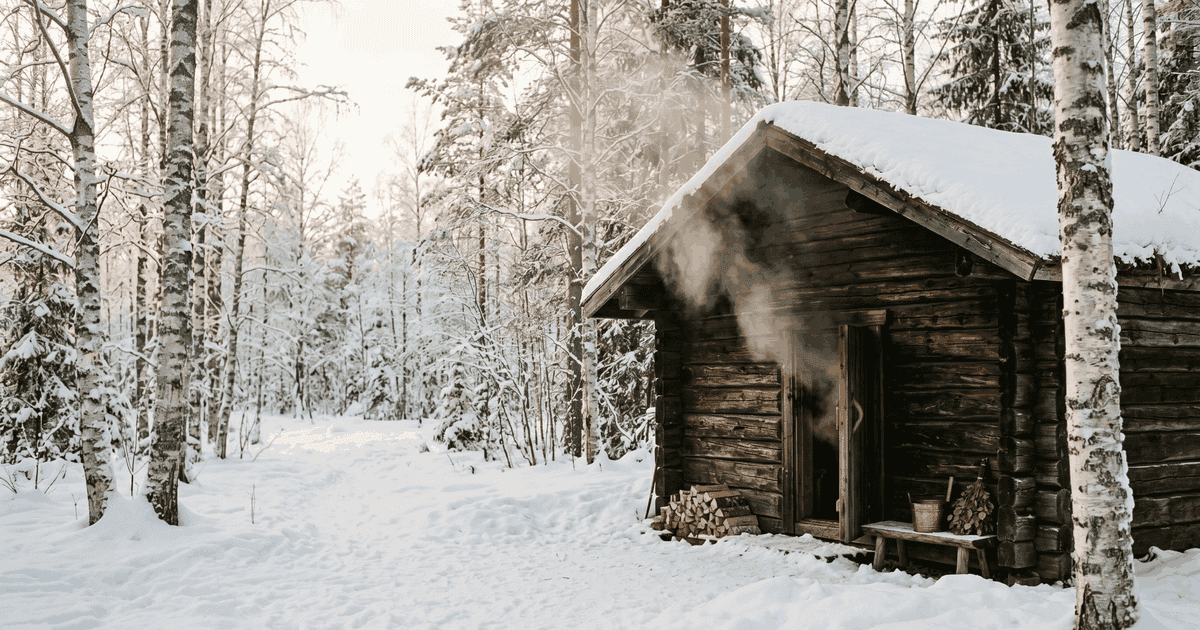
The defining feature is what it lacks: a chimney. A wood fire is built in a stone-lined pit or under a heavy stone bed. This is the kiuas (sauna stove). Smoke rises into the room itself rather than venting up a flue. Walls, ceiling, and benches darken over the years into the deep matte black that gives a working smoke sauna its signature look. The soot is not neglect. It is the surface that absorbs heat and radiates it back.
The stones sit directly above or around the fire, with no metal jacket in between. They take a long time to come up to temperature. They take just as long to give the heat back. That thermal mass is the second defining feature. A modern electric heater stops the moment its element switches off. A fully fired stone bed keeps radiating for hours. That is why a smoke sauna can hold a soft löyly long after the fire has been raked out.
The third feature is the venting hardware. A small ceiling hatch, an opening door, sometimes a roof funnel: these are the only paths the smoke has out. They are simple by design. A sauna that vents well is a sauna someone has shaped carefully over years.
The firing rhythm: load, burn, clear, bathe
A traditional firing typically runs four to eight hours. The exact time depends on the size of the cabin, the dryness of the wood, and how cold the room starts. Birch and alder are the usual choices. The fire is fed in waves rather than as one big load. An initial burn brings the stones up. Subsequent loads layer more heat into them while smoke continues to wash the walls.
During this stage the door is often left ajar and the ceiling hatch open. Combustion air flows in and excess smoke drifts out. The room is not yet a sauna. It is a furnace with a slow, dark cloud in it. Bathers are nowhere near.
Then comes the clearing phase. Newcomers underestimate this step. After the last load has burned down and the embers have been raked out, the room has to vent. The Finnish Sauna Society's house rule is to allow at least an hour for the embers to die and the smoke to escape before anyone bathes. Estonian Võromaa (Võro region, southeastern Estonia) smoke-sauna keepers describe a similar wait. The air must be completely clear to the ceiling before the door is closed for the session.
Only then does the bathing phase begin. The stones, saturated with heat, throw a notably soft, humid löyly (burst of steam from water on hot stones) when water meets them. Many bathers describe this löyly as the reason for the whole exercise. It feels gentler and more enveloping than the sharp pulse a modern electric heater produces. A typical session sits around 70–82 °C (158–180 °F). That is lower than a hot electric sauna, but the humidity reads warmer than the thermometer suggests.
Load, burn, clear, bathe. Half a day, give or take.
Carbon monoxide and the safety boundary
The same chimneyless geometry that gives the savusauna its character also makes it the most carbon-monoxide-exposed form of sauna. Burning wood produces CO. With no flue to carry it away, the CO accumulates in the room during firing. Levels peak when fresh wood is added or when the hatch is closed. CO also lingers in any unburned embers left in the stone bed.
CO is colorless, odorless, and gives no warning before it makes a person sick. The early symptoms are headache, dizziness, weakness, nausea, and confusion. These read like the flu. Bathers in a hot room may misread them as ordinary heat fatigue until it is too late. The Finnish Sauna Society's guidance is explicit. Clear the embers. Vent the room until the smoke is entirely gone. Only then close up and bathe.
Heads up
Carbon monoxide warning. Never enter a smoke sauna while smoke is still in the room. Allow at least an hour after the last load burns down. Rake the embers fully out of the stone bed. Vent until the air is clear to the ceiling before closing the door for bathing. Carbon monoxide is odorless and gives no warning. A battery-powered CO detector is a sensible addition when reviving an old cabin or running an unfamiliar one. Infants, older adults, and anyone with heart or lung conditions are more vulnerable to CO exposure.
This is the boundary that separates a savusauna from a romantic idea of one. The methodology is not optional. A well-run smoke sauna is safe in the same way a wood stove is safe. Respect what it is. Follow the steps. Do not skip the clearing phase.
Living traditions: Finnish heritage cabins and Estonian Võromaa
Through most of the twentieth century the smoke sauna almost vanished. Chimney saunas replaced it across Finland and Estonia for the obvious reasons. They were faster, less work, and less soot to manage. By the post-war decades the savusauna survived mostly in remote farms and in the memory of older bathers.
Two institutions kept it alive into the present. In Finland, the Finnish Sauna Society (Suomen Saunaseura, founded 1937) runs a sauna house at Vaskiniemi in Helsinki. The building dates to 1952. It holds three working smoke saunas alongside other wood-burning and electric rooms. The Society treats the smoke sauna as a living heritage object rather than a museum piece behind glass. The cabins are fired, used, and maintained week after week.
In Estonia, the savusauna tradition never fully broke. Southeastern Estonia kept building and firing smoke saunas through the decades when most of the rest of the Baltic moved on. The Võromaa region and the neighboring Setomaa cultural area were the strongholds. In 2014, UNESCO inscribed the Smoke sauna tradition in Võromaa on its Representative List of the Intangible Cultural Heritage of Humanity. The inscription recognizes not only the buildings themselves but the bath whisks, the smoking of meat, the construction skills, and the bathing customs that surround them. Setomaa shares many of these practices, but the inscription itself names Võromaa.
Both traditions look outward now. Saunaseura hosts visitors and trains new keepers. Võro farms welcome travelers who want to experience the firing rhythm for themselves. The form survived because people decided it was worth the labor.
Why people still build them
The honest answer is partly the löyly. A fully saturated stone bed gives steam a quality that an electric heater cannot match. It feels softer at the skin and broader in the room. It also fades more slowly between throws. For bathers who know the difference, that alone is the case for the form.
The other half of the answer is the half-day commitment itself. A smoke sauna firing is not an interruption between meetings. It is an afternoon of feeding the fire, watching the stones change color, raking embers, and waiting for the air to clear. The work is the ritual. The bathing at the end is the resolution. People who build a savusauna in 2026 are choosing the rhythm as much as the room.
It is also, quietly, an act of preservation. Every working smoke sauna is a living piece of a tradition that almost disappeared. The tradition depends on someone, somewhere, still being willing to clear the embers and open the hatch.
Sources
- Smoke sauna tradition in Võromaa (UNESCO ICH 00951) — UNESCO Intergovernmental Committee for the Safeguarding of the Intangible Cultural Heritage, 2014
- A good smoke sauna — Finnish Sauna Society
- Sauna Society — Sauna House at Vaskiniemi — Finnish Sauna Society
- Hyvien löylyjen salaisuus 2.0 — Saunan muotoilu ja suunnittelu — Lassi A. Liikkanen, 2022
- Carbon Monoxide Poisoning Basics — Centers for Disease Control and Prevention
- An inside look at the traditional Võro smoke sauna from South Estonia — Adam Rang (Visit Estonia), 2026
- Savusauna: What is the Traditional Finnish Smoke Sauna? — Saunology