Stones
Sauna stones replacement — when, how, and why
Replace sauna stones every 1–3 years: signs they're worn, how to swap them safely, stone-type picks, and what skipping the job costs your heater.
Suoraan asiaan (straight to it)
Bottom line: Sauna stones break down every 1–3 years of regular use. Replace them when they crumble underfoot, ring dull, or pack tight enough to choke airflow — running a heater on dead stones cooks the element and weakens löyly.
Key facts:
- Replacement cadence: 1 year heavy use, 2–3 years weekly use, 5 years light use
- Stones must lie loose so air flows around the element — never wedge them in
- Olivine, peridotite, and ceramic stones are the three common materials sold
- Stone weight per load: 15–25 kg for a 6 kW heater, up to 100 kg for towers
- Run heater empty for 30 minutes after replacement to burn off stone dust
Replace your sauna stones every one to three years, sooner if you bathe daily. The stones look like furniture, but they are wear parts. They split, crumble, and pack tight under thermal stress. A heater running on dead stones costs you energy, a weaker löyly (the burst of steam from water on hot stones), and eventually a fried heating element.
Why sauna stones break down
Every session, the stones cycle from room temperature to roughly 400–500 °C (752–932 °F) and back. Each splash of water cools the surface by tens of degrees in a second. That shock fractures the rock from the inside out. Olivine and peridotite handle it better than most, but no stone is immune.
As stones break, three things happen at once. Surface area drops, so the kiuas (sauna stove) stores less heat between löyly throws. Dust and chips fill the gaps between stones, choking airflow around the element. And the element itself sits hotter than it should, because the convection channel above it has collapsed.
The energy cost is measurable. Harvia tested a 10 m³ (353 ft³) sauna under two conditions: loose new stones versus tight old stones. After one hour, the room was 10 °C warmer with new stones. The heating element ran at 580 °C instead of 680 °C. A hundred-degree drop in element temperature is the difference between a heater that lasts fifteen years and one that fails in eight.
How often to replace by usage level
The single "every two years" rule you see online hides a 5x spread. Cadence scales with sessions per week, and the major heater brands publish different numbers for the same reason: their warranty pools see different usage patterns.
A usable ladder for home owners:
- Daily or commercial use (5+ sessions per week): rearrange every 3–4 months, full replacement at 12 months.
- Weekly use (1–3 sessions per week): rearrange at 6 months, full replacement at 2–3 years.
- Light use (occasional, under 1 session per week): inspect annually, full replacement at 5 years.
If you prefer running hours to calendar months, the rule of thumb is 300–400 hours of heating per replacement cycle. That maps cleanly onto the brand guidance: HUUM publishes a 300-hour check window and a 400-hour replacement window, and Harvia recommends an annual look regardless. Public saunas are simpler — full replacement once a year, monthly visual inspection, no exceptions.
Finnish sauna tradition treats the stones as renewable, not permanent. Buying one extra 15–20 kg box at install time and storing it in the garage is the cheapest insurance policy in the entire sauna.
Signs it's time to swap them
Four cues, in roughly the order they appear:
- Color shift. Dark olivine fades to light grey, rusty brown, white, or green. Mineral deposits from tap water leave a chalky crust.
- The tap test. Lift two stones from the top layer and knock them together. New stones give a clean, almost ceramic clink. Worn stones produce a dull, hollow thud, or one of them simply breaks in your hand.
- Crumbles on the floor. Look under the heater. Stone dust, gravel, or chips pooling there means the load above is shedding. You will also find these crumbles in the drip tray of kiuas models that have one.
- Weaker löyly and longer heat-up. If the same ladle of water now barely registers as steam, the stones are done. Same goes for a heater that used to hit 80 °C in 40 minutes and now takes 60.
Discoloration alone does not always mean replacement. A sooty grey film from old splash water washes off in a rinse, and a single chipped stone gets pulled and tossed. But two or more of the cues above hitting at once means a full swap, not a touch-up.
The replacement procedure
The job takes about an hour for a home heater and needs only three tools: a bucket, a stiff brush, and a headlamp. Work in this order:
- Cut power and wait. Switch the heater off at the wall and trip the breaker for the sauna circuit. Wait at least four hours after the last session, ideally overnight. Hot stones and a live element are the only real hazards in this job, and both are easy to avoid.
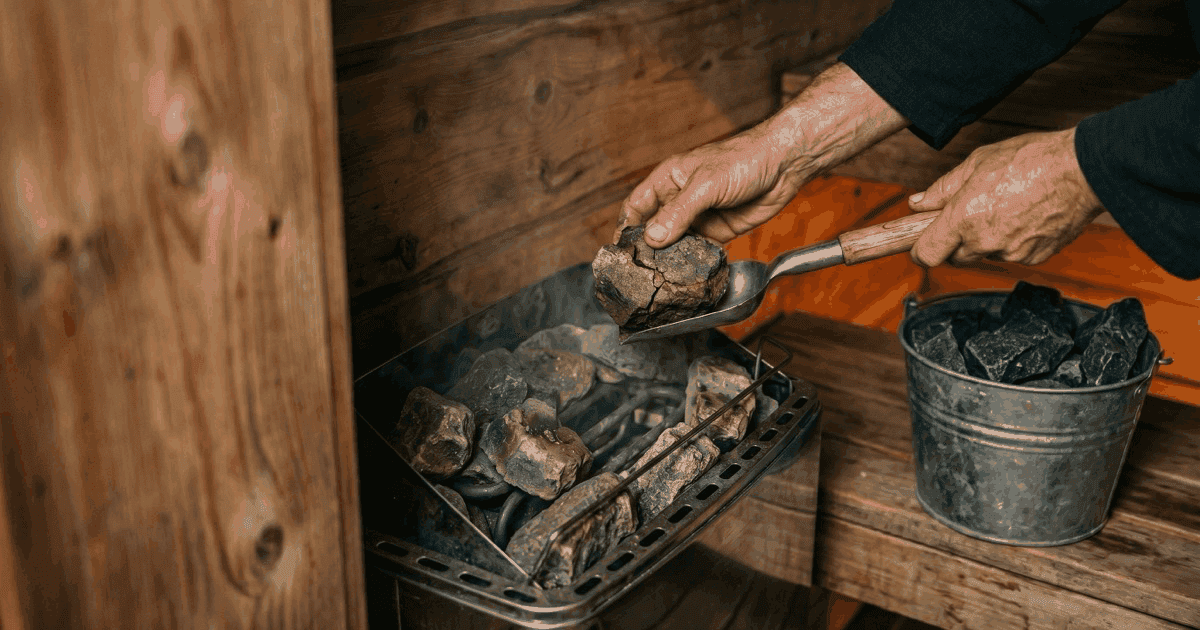
- Unload the old stones. Lift them out one by one into a bucket. Use the headlamp to spot dust and chips down at the element. If you find a heater with stones jammed in tight or pressed against the resistors, that is the reason you are here.
- Clean the cavity. Brush stone dust and shards out of the heater base. Wipe the element gently with a dry cloth. Do not use water on or around the element. Inspect the resistors for visible damage and the heater base for rust spots. A rust hole means a new heater, not new stones.
- Rinse new stones. Briefly rinse natural olivine or peridotite under cold tap water to remove transport dust. Skip this for ceramic stones, which should not be soaked.
- Load loose, large at the bottom. Place larger stones on the bottom and sides, smaller stones on top to fill gaps. Set elongated stones standing up, not lying flat — vertical orientation lets convection currents climb through the load. Never wedge a stone against the heating element; nest it gently so the element is supported, not pinched.
- Burn off the dust. With the door propped open and the room well ventilated, run the heater empty to full sauna temperature for 30 minutes. Natural stones release a noticeable mineral odor on first heat. After this burn-off, throw your first proper löyly.
A few things to skip. Do not pour stones into the heater from the box — every one of them needs to be placed. Do not stack the load above the rim or cover the top grille on tower heaters. And do not mix old and new stones, because the old ones will keep shedding into the gaps you just opened up.
Picking replacement stones and what to avoid
Three materials cover the residential market. Olivine diabase is the Finnish default. Peridotite is a denser cousin with similar thermal mass. Engineered ceramic uses round shapes designed for tower heaters. All three are sold in 15–20 kg boxes. As a rough heuristic, plan on 2.5–3 kg of stones per kilowatt of heater capacity.
| Heater style | Typical capacity | Stone load | Common pick |
|---|---|---|---|
| Small wall-mounted (4.5–6 kW) | 6–8 m³ | 15–25 kg | Olivine diabase, 5–10 cm |
| Mid-size wall-mounted (8–9 kW) | 9–13 m³ | 25–30 kg | Olivine diabase, 5–10 cm |
| Tower (HUUM Drop, Harvia Cilindro) | 10–20 m³ | 60–100 kg | Round olivine or ceramic, brand-matched |
Brand rules to know before you order. Tylö heaters reject ceramic stones outright — the brand's care guidance says ceramic shortens resistor life, and the standing recommendation is vulcanite or olivine only. HUUM heaters take only round stones, sold by the brand in 15 kg packs, because the open-cage design needs shapes that nest without bridging. Harvia is the most forgiving of the three. The brand still publishes a model-specific stone list, and the Spirit-line cylindrical heaters want round stones for the same airflow reason.
Avoid two categories entirely. Decorative landscaping stones — granite cobbles, river rocks, polished pebbles — were never tempered for sauna heat and explode unpredictably. And porous sedimentary stones like sandstone or limestone trap water inside, crack on the first cold splash, and can throw fragments at bench height.
Fresh stones, loose load, burn-off done. The heater pulls back to its original heat-up time, the element runs cooler, and the löyly returns to what the room is supposed to deliver. The cost of the job is one box of stones and an hour of attention every couple of years. Skipping it wastes about 100 kWh per year on a 9 kW heater. Eventually it costs a new heating element, around €150 plus install. Stones first, always.
Sources
- The easy guide to looking after your sauna stones — Harvia, 2023
- Changing sauna stones makes the sauna heat up faster — saving energy and time — Harvia, 2023
- How frequently should sauna stones be replaced? — HUUM
- Laying sauna stones into HUUM sauna heaters — HUUM
- Tylö Sauna FAQ — stone care and replacement — Tylö
- Kiuaskivien vaihto ja ladonta sähkökiukaaseen (Electric heater stone replacement) — Saunologia, 2020
- Mistä tunnistat vanhentuneen kiuaskiven? (How to recognise an aged sauna stone) — Saunologia, 2021
- Mitä oikeasti tapahtuu jos kiuaskiviä ei vaihda? (What happens if you don't replace sauna stones) — Saunologia, 2022
- Sauna Stones: Everything You Need To Know — Finnmark Sauna, 2024
- The Ultimate Guide to Choosing and Maintaining Sauna Stones — Sauna from Finland, 2024