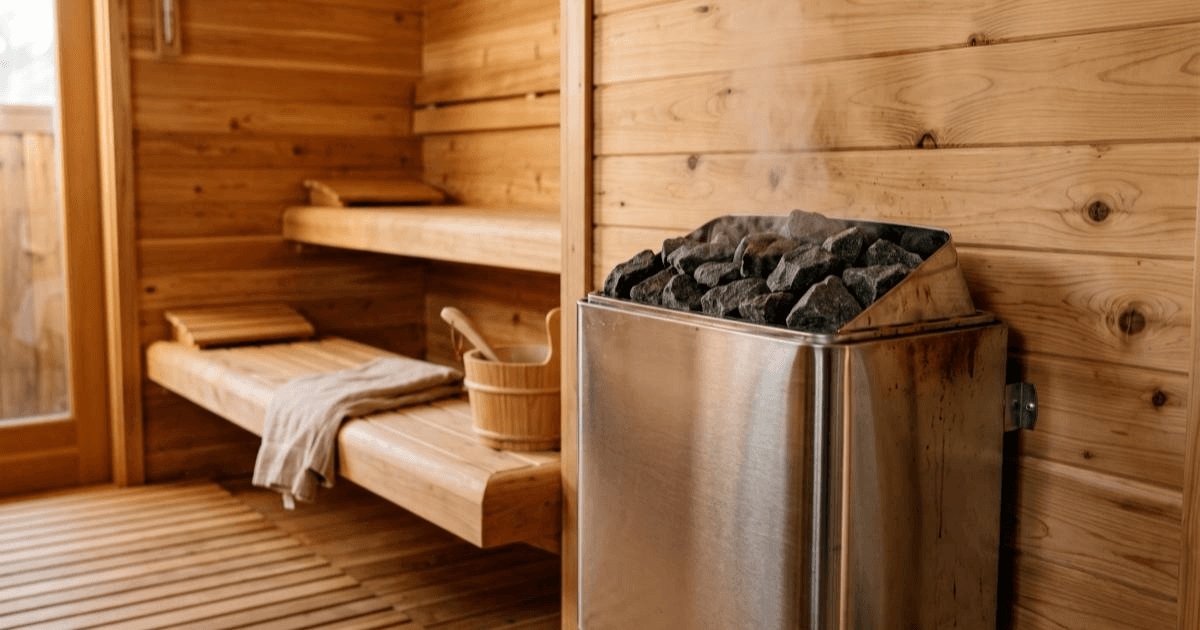
Heater brand overview
Tylö sauna heaters: the full Swedish brand lineup
Buying a Tylö sauna heater? A plain map of the Sense, Combi, and Pro families: sizing, controllers, Thermosafe, and who each one suits.
Suoraan asiaan (straight to it)
Bottom line: Tylö is the Swedish heritage sauna brand built around two ideas: a cool-touch Thermosafe shell and staged elements that hold a steady temperature. The Sense family covers most home saunas; Combi models add steam, and the Pro range scales up to large and commercial rooms.
Key facts:
- Tylö has built sauna heaters in Halmstad, Sweden since around 1949, now under the Sauna360 group.
- Sense Sport has built-in controls; Sense Plus and Combi use a separate Pure or Elite panel.
- Combi models add a steam tank for a softer, more humid sauna in the same room.
- Thermosafe coating keeps the heater's front and sides cool to the touch, near 40 C.
- Elite is the smart controller with a touchscreen, scheduling, and Wi-Fi app control.
Tylö is the Swedish heritage brand of the sauna heater world. Where rivals compete on stone mass or on-trend looks, Tylö leans on two engineering ideas it has refined for decades. The first is Thermosafe, a cool-touch shell. The second is staged elements that hold a steady room temperature instead of swinging hot and cold. For most buyers the question is not whether Tylö is good. It is which Tylö family fits your room and how you like to bathe.
Who Tylö is and what the brand stands for
Tylö started around 1949 in Halmstad, on the Swedish west coast. An electrician named Sven-Olof Janson wanted a heater that was cheaper and more efficient than what the market offered. The company still builds in Halmstad today. Over the years it added timers, stone compartments, and an automatic cut-off that trips if something combustible lands on the heater. Steam generators and shower products followed.
Ownership shifted in the 2000s. Tylö merged with the Finnish brand Helo to form TylöHelo, and the wider group now trades as Sauna360. That group also holds Helo, Kastor, Finnleo, and Amerec. For a buyer, the practical upshot is scale. Tylö sells through dealers across the UK, North America, and mainland Europe. Parts and replacement elements stay available for years. If you plan to own one sauna for a long time, that support network matters as much as the spec sheet.
The brand pitch rests on a few signature features. The Thermosafe coating keeps the front and sides of the heater cool, close to 40 C, so a brush against the housing does not burn. Staged, or divided, output means the elements do not simply switch fully on and off. They fire together to heat the room fast, then step down so fewer elements hold the target temperature. That trims the temperature swing and the running cost. Most Tylö heaters also carry a generous factory warranty, often cited at five years, though terms vary by market and by whether labour is covered.
The Tylö heater lineup at a glance
Tylö organises its electric range mostly by how you control it. The Sense family is the core home lineup, and it splits into three control styles. Sense Sport is the entry tier, with the controls built into the heater itself. Sense Plus keeps the same heater body but moves control to a separate wall panel outside the sauna. Combi models add a steam tank on top of all that. Above the Sense range sits the Pro line for large rooms, plus dedicated Commercial units for public facilities. Expression is the design-led glass-front heater that has won awards for its looks.
Here is a practical map for English-speaking buyers. Treat the numbers as typical ranges, since exact figures shift by region and voltage.
| Family | Control style | Typical use |
|---|---|---|
| Sense Sport | Built-in, on the heater | Small home saunas used often; simplest to install |
| Sense Plus | Separate Pure or Elite panel | Home saunas that want a wall panel by the door |
| Sense Combi | Separate panel, plus steam | Rooms 4-12 m³ where you want both dry and humid modes |
| Expression | Separate panel | Design-forward builds where the heater is on show |
| Pro / Commercial | Separate panel | Large residential, gyms, spas, and hotel saunas |
A Sense Sport in the 6-8 kW bracket suits a typical two- to four-person home cabin. The compact Sport Combi 4 sits at the small end, aimed at frequently used rooms around 4 m³. Step up to Sense Plus and you gain a proper wall panel and access to the smarter Elite controller. The Pro range reaches into the double-digit kilowatt tiers, roughly 10 to 14 kW, for rooms that outgrow a wall-mount. Commercial models climb higher again, up toward 20 kW, for the volumes a public sauna has to hold.
Combi, controllers, and the Thermosafe difference
The Combi models are the feature that sets Tylö apart from a plain stone heater. A Combi has a small water reservoir with its own element behind the rocks. Fill it, switch to Combi mode, and the heater raises humidity while the stones stay hot. That gives a softer, more humid session at a lower temperature. It is not a steam room. The walls do not soak, and you can still pour water for a sharp burst of löyly (the wave of steam off hot stones). After a steam session the heater runs a drying cycle, baking the empty room near 80 C for about twenty minutes to keep the wood dry. Our full Sense Combi review walks through the trade-offs in depth.
Controllers are the other axis of the decision. Tylö sells two main panels. Pure is the simpler unit, showing time and temperature on a plain numbered scale with a preset timer. Elite is the smart upgrade. It brings a touchscreen, real humidity readout on Combi models, scheduling so the room is ready at a set time, and Wi-Fi app control from your phone. Elite can also drive extras like an auxiliary fan, a fragrance pump, or a sound system. If a smart, app-controlled sauna is the goal, Elite is the panel to specify. Our guide to who actually needs a smart controller can help you decide whether that upgrade earns its price.
Thermosafe ties the range together. The flocked, velvet-like coating on the shell keeps the exposed surfaces cool enough that many jurisdictions do not require a separate heater guard. Combined with the automatic cut-off, that makes Tylö a sensible pick for a family sauna where children are around. The staged elements back this up on the running-cost side, holding a flatter temperature curve than a simple on-off heater.
Sizing a Tylö heater to your room
The sizing rule for Tylö is the same one that governs any electric heater. Start near 1 kW of heater power for every cubic metre of cabin volume. A 6 m³ room wants roughly a 6 kW heater, and a 10 m³ room wants about 10 kW. From there, adjust for anything that leaks heat. A glass door, an outside wall, or tile and stone surfaces all make the room behave larger than its raw volume. When your cabin has a lot of glass, size up rather than down.
That rule is why the Sense Sport and Plus models cluster in the 6-8 kW band. Most home saunas land between about 4 and 12 m³, which those tiers cover cleanly. If your room sits above that, the Pro range is the honest answer rather than pushing a Sense heater to its limit. A heater run flat out at its top-rated volume struggles to recover after a heavy water throw. Our heater sizing guide shows how to work the adjustments, and the room dimensions guide helps if you are still planning the cabin itself.
One firm safety point applies to every model above the smallest plug-in tiers. Wiring a Tylö heater is a licensed-electrician job, done to your local electrical code. The correct breaker size and cable gauge depend on the exact model, the voltage, and whether the supply is single- or three-phase. Do not copy a breaker or cable number from a forum or from a heater sold in another country. Match the SKU to your supply, and let the electrician confirm the circuit from the heater's own rating plate.
Where Tylö fits versus Harvia, HUUM, and Saunum
Each major brand owns a different wedge, and naming them makes the Tylö decision easier. Harvia is the breadth leader, fielding everything from a tiny plug-in electric to a wood-burning cabin stove from one catalog. HUUM wins on industrial design, with photogenic heaters and a controller bundled in. Saunum sells air-mixing heaters that even out the temperature between your head and feet. Tylö's wedge is Swedish engineering heritage, the cool-touch Thermosafe shell, and the steady-temperature staged elements.
That points to a clear buyer. Tylö suits someone who values a safe, cool-to-touch housing, a flat and economical temperature curve, and a proven dealer network in the UK and North America. The Combi option is a genuine draw if you want both dry and humid modes without a separate steam build. Where Tylö is less obviously the pick is raw stone mass and dramatic looks. A large cylindrical Harvia or a sculptural HUUM holds more rock and makes a bolder centrepiece. If those are your priorities, look there first.
The short decision tree runs like this. Choose Sense Sport if you want the simplest install and controls on the heater. Choose Sense Plus with an Elite panel if you want a smart, scheduled sauna. Choose a Combi if steam is part of the plan. Choose Pro or Commercial if the room is large. Whichever you pick, the Thermosafe shell and staged heat are the constant, and they are the reason Tylö keeps its loyal following.
Sources
- Tylö sauna heater packages and range overview — Tylö, 2026
- Tylö — electric sauna heater Sense Combi Pure — Tylö / TylöHelo
- Tylö — electric sauna heater Sense Elite — TylöHelo
- About Tylö — Swedish wellness craft and company history — TylöHelo
- Sense Sport 7 electric sauna heater 7 kW — Tylö — The Sauna Place
- Tylo sauna heaters buyer information — SaunaFin
- Tylo Sauna Heaters — brand overview and Thermosafe features — Sauna-Talk