Culture & history
Why Finland has more saunas than cars — the cultural anchor
Finland has roughly 3.2 million saunas for 5.5 million people, outnumbering passenger cars. Here is the history of how the sauna became a national fixture.
Finland has roughly 3.2 to 3.3 million saunas for about 5.5 million people. That is nearly one sauna for every household, and more saunas than the country has passenger cars. The number is not an accident of taste. It is the product of a few centuries of practical necessity, a wave of urban migration, and a national habit that survived every change it passed through.
The number behind the claim
The headline figure comes from Finland's own institutions. The UNESCO heritage listing counts 3.3 million saunas for 5.5 million inhabitants. Finland's heritage authority puts the figure at 3.2 million. Either way, saunas roughly match the number of Finnish homes. Few countries can claim a piece of infrastructure that scales one-to-one with households.
The comparison to cars is close, and worth stating precisely. Finland has about 2.8 million registered passenger cars. Against that number, saunas win comfortably. Count every vehicle on the road, including vans, trucks, and buses, and the total climbs past three million. At that point the two figures run neck and neck. So the honest version of the claim is simple. Finland has more saunas than passenger cars, and about as many saunas as vehicles of every kind. That a small northern country even reaches that ratio is the real story.
The usage figures are just as striking as the count. Almost 90 percent of Finns bathe in a sauna at least once a week. Around 40 percent go more than once a week. The sauna is not a luxury reserved for cottages or spas. It is a room most Finns use as routinely as a kitchen. That frequency is what turns a large number of buildings into a living tradition rather than a collection of unused rooms.
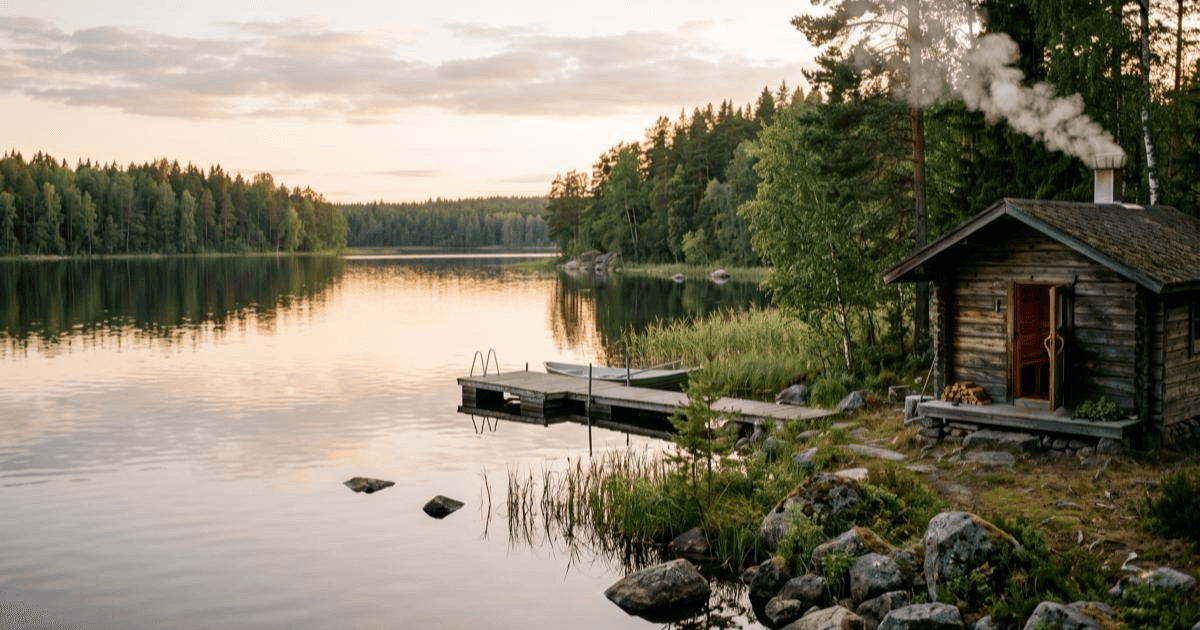
Counting saunas is harder than it sounds, which is why the estimates vary. A private apartment sauna is easy to tally through building records. A summer-cottage sauna by a remote lake is not. Neither is a small backyard savusauna (smoke sauna, heated by burning wood directly under the stones and vented before bathing). Some cautious counts land nearer 2.7 million by sticking to registered buildings. The looser counts that fold in cottages and public facilities push past three million. The range itself tells the story. Saunas are so ordinary in Finland that the country cannot precisely count its own.
How the sauna became universal
For most of Finnish history, the sauna was the most practical place to get clean. Winters were long, hot running water was rare, and a wood-heated room that held its warmth solved the problem. Farms built the sauna first, sometimes before the main house, because the whole household depended on it.
The room did far more than wash bodies. It smoked meat, malted grain for brewing, and dried linen through the cold months. It was warm and clean enough that women gave birth there, and the dead were washed there before burial. That dual role, as the site of both birth and death, gave the sauna a weight in the household that no other room carried. It was treated as something close to sacred, a warm and honest space where the ordinary rules of the house relaxed.
On a working farm, the sauna also organized the week. It was heated once, usually on a Saturday, and the whole household bathed in turn as the room slowly gave up its warmth. The bathing order followed the household hierarchy, but the heat itself was shared down the line so that nothing was wasted. Because most farms held only one sauna, the room was communal by design rather than by choice. That habit of sharing a single hot space, instead of each person heating their own, is the root of the etiquette Finns still bring to public saunas. The sauna was never a private indulgence. It was a resource the household planned its week around.
The oldest form is the savusauna. It is the ancestor of every later design. Its long, deep, soft heat is why some Finns still consider it the truest form of the ritual. The habit was portable, too. A wartime field manual noted that a battalion needed only about eight hours to build saunas, warm them, and bathe. Wherever Finns went, the sauna tended to follow within a day.
From the farm to the apartment block
The sauna nearly did not survive the move to the city. From the late 19th century, Finns left farms for factory work in growing numbers. Cramped urban housing had no room for a smoky log bathhouse. Fire risk made insurers wary, and the old chimneyless design did not fit a tenement. For a time, the tradition looked like a rural relic that city life would quietly leave behind.
Two shifts saved it. Public bathhouses opened across the growing cities. They gave factory workers an affordable place to keep the weekly ritual alive, and they kept the habit intact through the hardest decades of urban migration. Then, in the 1930s, the electric kiuas (sauna stove or heater) arrived. A clean, fire-safe heater with no wood litter could go into a building where an open fire never could.
That invention rebuilt the sauna into modern life in stages. Shared saunas appeared in large housing blocks through the 1960s, booked in rotating hours for the building's residents. In the 1970s, saunas began going into individual apartments, and the idea spread quickly. By the 1980s, most Finns lived in towns, and a private sauna had become a standard expectation of a Finnish home. It was no longer a special feature but a default one.
The shared apartment-building sauna deserves its own note, because it carried the rural habit straight into the city. In a typical block, the building sauna runs on a weekly schedule, with set evenings for men, for women, and for residents who book a private slot. Neighbors who might otherwise never speak share the same benches in the dark and the heat. That arrangement kept the communal spirit of the farm sauna alive even as families moved into separate flats. For many Finns who grew up in the postwar housing boom, the building sauna was where the ritual was first learned. The shared sauna still exists in countless blocks today. Even the floating and lakeside saunas that dot the shorelines trace back to the same refusal to give the ritual up.
What the density says about Finland
The sheer number of saunas is really a statement about who gets to use one. Saunas sit in modest flats and in corporate headquarters alike. The parliament has one. So does the president. Finnish embassies abroad build them into their premises. An invitation to a sauna from a business contact you have never met is normal rather than strange.
That spread carries a social logic. Inside the hot room, rank tends to fall away, and a cabinet minister may share a bench with a welder. Everyone sits at the same temperature, without the props of office or wealth. The sauna became a place to talk plainly and, at times, to make decisions. That is why sauna diplomacy is a genuine Finnish tradition rather than a tourist slogan. The density is what makes the equality possible. When nearly every home and institution has a sauna, no one is shut out of the room where the honest conversation happens. Visitors curious about how that plays out can read the unwritten rules of Finnish sauna culture before a first session.
The habit also supports a real industry. Finland is home to dozens of sauna-construction firms and heater manufacturers. The domestic market for building saunas and stoves runs into the hundreds of millions of euros each year. A national habit at this scale sustains its own supply chain. That supply chain keeps saunas affordable and easy to build, which in turn keeps the habit alive. Demand and infrastructure reinforce each other in a loop that has held for generations.
In December 2020, UNESCO added Finnish sauna culture to its list of the intangible cultural heritage of humanity. It was the first Finnish tradition to earn the honor. The nomination itself grew out of years of work by Finnish sauna societies, the volunteer groups that keep the old knowledge alive and pass it to new bathers. What the listing recognized was not the buildings but the living practice around them. Heating the room, throwing water on the stones, the songs and beliefs and folklore of the sauna, all of it counts as the heritage. The listing changed nothing about daily practice. It simply formalized what the numbers already showed. The sauna is not a building Finns happen to own in large quantities. It is a living habit they have carried, unbroken, from the farm to the apartment block. The count of saunas is only the most visible measure of a ritual most of the country still keeps every week.
Sources
- Sauna culture in Finland — UNESCO Intangible Cultural Heritage of Humanity — UNESCO, 2020
- Sauna culture in Finland inscribed on UNESCO's List of Intangible Cultural Heritage — Finnish Heritage Agency (Museovirasto), 2020
- Finland, a land of saunas — Finland Toolbox (thisisFINLAND), 2024
- Bare facts of the sauna in Finland — Mikko Norros, 2015
- The Finnish Sauna Society (Suomen Saunaseura) — Finnish Sauna Society, 2020
- Finnish sauna — Wikipedia contributors, 2026