Specialty saunas
Trailer and mobile saunas: the road-going Finnish sauna
How trailer and mobile saunas work: tow-behind builds, pop-up event rentals, wood vs electric heat, and why the road-going Finnish sauna took off.
A mobile sauna is a full, working Finnish sauna built onto a road-legal platform. The hot room comes to you instead of the other way around. The most common form is the tow-behind trailer. The same idea also runs through van and truck conversions, and through the pop-up units that show up at events. This guide covers the land-based, road-going sauna. It looks at how the form started, how it is built and heated, and why it became one of the fastest-growing corners of sauna culture.
From lakeside cabin to the open road
For most of its history, the Finnish sauna was fixed to one place. It was a lakeside cabin, a farmyard outbuilding, or a room in the house. Sauna is woven deep into everyday Finnish life. The country counts roughly 3.2 million saunas for about 5.5 million people. Close to 90 percent of Finns bathe at least once a week. When something is that normal, taking it on the road is a small step rather than a strange one.
The road-going sauna has a real military lineage. Finnish forces built transportable saunas during the Second World War. Troops used them to wash and warm up in the field, treating a hot room as basic hygiene rather than a luxury. Sled-mounted and tent saunas did the same job in remote camps and on the ice. These were practical machines, not wellness products. They proved a simple principle that still holds. If you can heat stones and trap the heat, the structure around them can move.
From that base, the modern peräkärrysauna (trailer sauna) grew steadily. Trailers, insulation, and small wood-burning stoves all became cheap and standardized. In Finland, a sauna bolted to a light trailer turned into an ordinary thing to own or borrow. Hunting clubs, sports teams, and summer-cottage neighbors passed the same unit around. It went where the fixed sauna could not: a race paddock, a construction camp, a friend's backyard for a party.
The current wave, with its polished builds and rental fleets, is really that old habit meeting better hardware. Insulation is thicker, stoves are cleaner-burning, and trailers are lighter and more stable. Add a global appetite for the sauna experience, and the road-going sauna spread well beyond the Nordic countries. What began as an army field expedient is now a small industry, sold on quiet wheels and a heritage story.
What counts as a mobile sauna
Mobile sauna is an umbrella term. It helps to split it into three road-going forms. Each one solves the same problem, moving a working hot room, in a slightly different way.
- Tow-behind trailers: a sauna cabin on a trailer chassis, pulled by a car or van. This is the dominant form and the one most rental operators run.
- Van and self-propelled conversions: a sauna built into the cargo box of a van or box truck. The vehicle drives itself to the site, with no separate trailer to reverse and park.
- Pop-up and event units: trailers or modular cabins made to be dropped at a venue. They are fired up for a day or a weekend, then towed away, often as part of a rented package.
The chassis under these builds is deliberately varied. Early North American builders reused horse trailers, cargo trailers, and old delivery trucks. Those platforms were affordable and already road-legal, which cut the cost of getting started. One well-known conversion began life as a bread truck. It measured about 6 feet 10 inches wide and 15 feet 10 inches long. The builder picked it because the extra width left room for benches once the walls were lined.
There is one clean boundary worth stating up front. This guide is about saunas that travel on roads, on wheels, under their own registration or a tow ball. It is not about the floating sauna. It does not cover the raft-mounted saunalautta (floating sauna built on a raft) or the sauna built into a boat hull. Those travel on water and follow their own rules and traditions. The two families overlap in spirit and almost nowhere else.
How a trailer sauna is built and heated
A trailer sauna is a small, well-insulated timber room sitting on a road chassis. The build order is close to a fixed sauna, just compressed. The walls take a vapor barrier and insulation first. Then comes an inner cladding of aspen, alder, or thermally treated softwood. Benches run along one or both sides. Every builder fights the same enemy, which is space. Insulation, an air gap, and siding all eat into the finished interior. A shell that looks generous from outside can seat fewer people than expected once it is lined.
Traceable specs from a long-running Finnish maker give a sense of the real numbers. Its smaller trailer sits on a platform around 3050 by 1500 mm and weighs roughly 690 kg. The larger model runs to about 3500 by 1800 mm and roughly 900 kg. Both use a single galvanized axle with small 13-inch road tyres. Overall width lands near 1910 mm, and the units are rated to tow at about 100 km/h. Numbers like these matter for a simple reason. The whole build has to stay light enough and narrow enough to be legal and stable behind an ordinary vehicle.
Heating splits along a familiar line. Off-grid trailers usually run a wood-burning kiuas (sauna stove or heater). It needs only firewood and a flue, so the sauna works in a field with no hookups. That freedom is the main reason wood dominates the mobile world. A wood fire also heats the room fast, which suits a unit that may only run for a few hours at a stop.
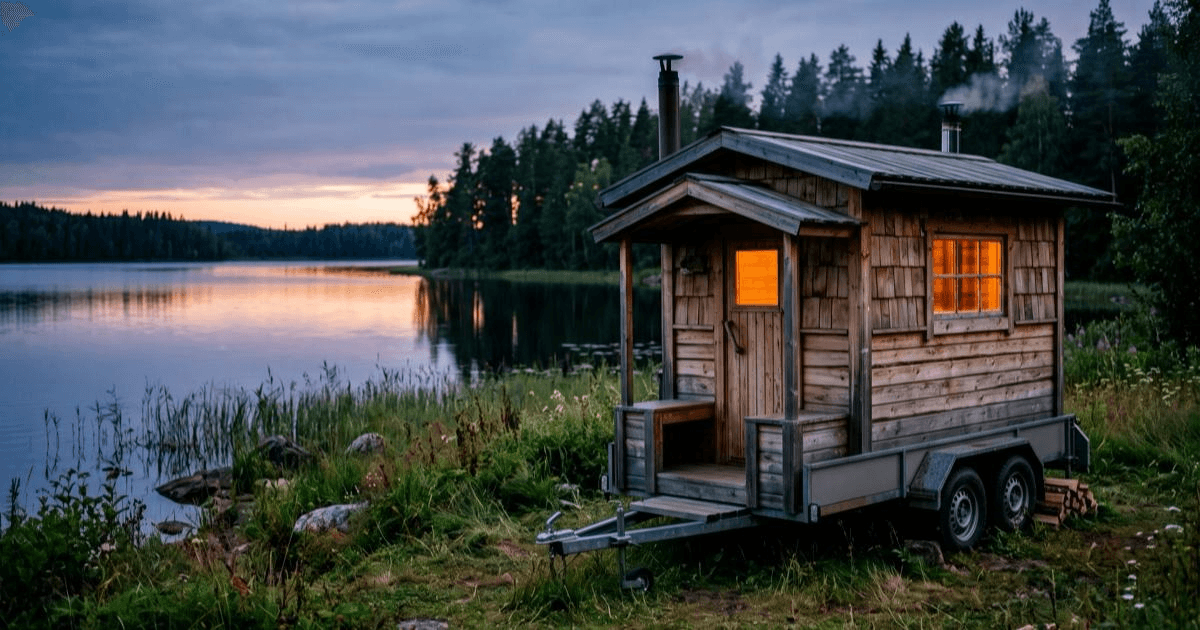
Electric heaters appear on units that will mostly park where power is available. They are simpler to run and produce no smoke, but they need a suitable supply at the site. Some builds use propane as a middle path between the two, trading a gas bottle for freedom from firewood. A wood-burning stove is also what gives a trailer sauna its stovepipe and its plume of wood smoke. That silhouette, a timber box with a metal chimney, is the visual signature of the form.
Note
Weight is the quiet constraint behind every mobile sauna. Stones, a steel stove, timber, and water add up fast. The total loaded weight has to stay inside what the chassis and the towing vehicle are rated to carry. Getting this wrong is a road-safety problem, not a comfort one.
Why mobile saunas caught on
The modern rental wave is young. In North America, the mobile sauna became a public, bookable experience around 2010. Early operators started hauling wood-fired trailers to lakes, markets, and winter events. The idea spread because it removed the two biggest barriers to trying a real Finnish sauna. You did not have to own one, and you did not have to travel to find one. The sauna simply arrived and fired up.
Events turned out to be the perfect fit. A trailer sauna at a festival, a wedding, or a cold-plunge meetup gives people a shared, memorable experience. The host takes on almost no permanent commitment in return. Operators lean into this. Their units seat anywhere from a handful of bathers to a dozen, arrive a few hours before guests, and leave with the trucks. Pricing runs from a few hundred for a day up into the low thousands for a full weekend package. Official Finnish tourism promotion now features these movable saunas alongside the classic cabin. That is a sign the form has moved from novelty to a recognized part of Finnish sauna culture.
The wider wellness boom did the rest. Cold plunging, contrast bathing, and communal heat all went mainstream far outside the Nordic countries. The mobile sauna gave that trend a vehicle, quite literally. It is cheaper to launch than a bricks-and-mortar spa. It can chase demand from one town to the next. And it carries an unmistakable heritage story wherever it parks.
The early years were not frictionless. Some operators struggled to insure a wood-fired room on wheels, since insurers had no obvious category for it. Chassis and towing rules also vary by country and by state, so a build that is routine in one place needs paperwork in another. None of that stopped the format. It grew fastest where a lake, a plunge tub, or a cold river sat close by, because the contrast between heat and cold is the whole draw. A trailer can park a hot room a few steps from open water, which a fixed spa rarely manages.
Strip away the trailer and the fleet economics, and a mobile sauna is the same thing it always was. It is hot stones, a tight timber room, and good löyly (the burst of steam from water poured on hot sauna stones). The road chassis just means the oldest habit in Finnish life can now show up in a parking lot, a driveway, or a field. Then it can be gone by morning.
Sources
- Sauna culture in Finland — UNESCO, 2020
- The sauna culture in Finland has been inscribed on UNESCO's List of Intangible Cultural Heritage — Finnish Heritage Agency, 2020
- Mobile sauna | Trailer sauna | Finn Projektit Finland — Finn-Projektit
- Mobile Saunas — Glenn Auerbach, 2019
- Chassis Considerations for a Mobile Sauna Build — Wade Litt, 2021
- Mobile and Trailer Saunas: The Complete Guide to Portable Heat Therapy on Wheels — Haven of Heat, 2025
- Renting a Mobile Sauna: The Next Big Event Trend? — Celsium Wellness