Heater technology choice
Climate-control heaters (Saunum) — when they earn the premium
Climate-control heaters like Saunum blend hot ceiling air with cool floor air for even heat. Who benefits, who should skip the premium, and cheaper fixes.
Suoraan asiaan (straight to it)
Bottom line: A climate-control heater like Saunum earns its premium when a room stratifies badly and geometry cannot fix it: low benches, tall ceilings, or seated bathers. If you can build high benches with good ventilation, cheaper design does the same job.
Key facts:
- A built-in fan blends hot ceiling air with cool floor air for even head-to-toe heat
- Makers claim the ceiling-to-floor temperature gap drops by over 60%
- Strongest payoff: tall ceilings, single low benches, or seated and older bathers
- The fan switches off, so you can still run a classic natural-convection session
- Cheaper fixes first: raise the top bench and tune inlet and outlet ventilation
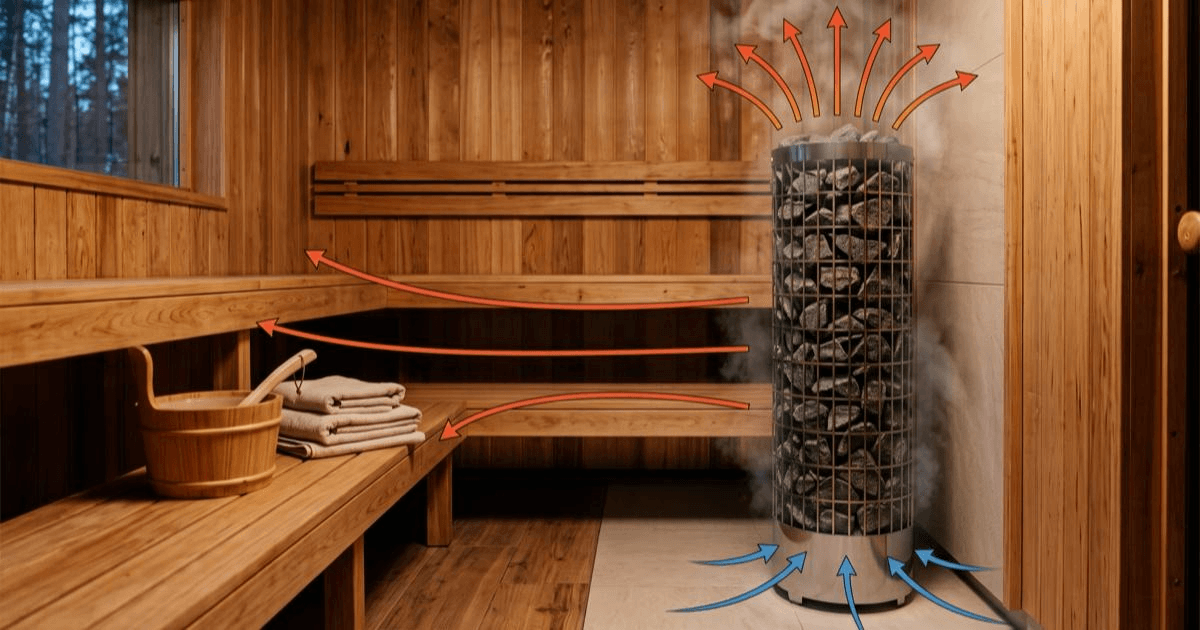
A climate-control heater does one thing a normal heater does not. It runs a built-in fan that pulls the scorching air off the ceiling. It mixes that with cooler air near the floor, then pushes an even, softer blend back into the room. Saunum is the brand most people mean here, and it is a real fix for a real problem. The question is whether your sauna has that problem, or whether better design solves it for free.
Every sauna stratifies. Heat rises, so the top bench runs hot and the floor stays cool. In a poorly shaped room, a bather's head on the upper bench can sit near 85 °C (185 °F). Their feet on a lower tier may hover around 45 °C (113 °F) at the same moment. Some of that gradient is the point. But past a certain gap it stops feeling like a sauna and starts feeling like a headache with cold feet. That gap is exactly what a climate-control heater flattens.
What a climate-control heater actually does
Strip away the marketing and the mechanism is simple. A tall, column-style heater houses a small fan and an air path. The fan draws the hottest air from the top of the room. It blends that with cooler, oxygen-rich air pulled in low near the floor. Then it returns a mixed air-and-steam stream at a steadier temperature. Makers claim this cuts the ceiling-to-floor temperature gap by more than 60%. A room that swings some 80 °C top to bottom can end up swinging closer to 25 °C.
The knock-on effects are the selling points. Air pulled from floor level carries more oxygen, so a full room feels easier to breathe. The löyly (the burst of steam from water on hot stones) reaches your whole body instead of stalling at the ceiling. That makes the steam feel softer and last longer. On the integrated heaters the fan speed is adjustable, from a gentle mix for relaxed sitting up to a stronger blend for active sweating. Some models bundle a salt-ion feature and Wi-Fi scheduling on top, though those ride along with the climate tech rather than defining it.
One detail matters for purists, and the brands are upfront about it. The fan switches off. Turn it off and you are left with an ordinary tall electric kiuas (sauna heater) running natural convection. You get the same steep gradient and sharp steam a classic stove gives. So the climate feature is a mode you can add, not a character you are locked into. That single fact defuses most of the objection to it.
Who the premium is genuinely for
Three situations make the climate feature worth its price, and they share a theme. Each is a case where you cannot fix stratification with room geometry alone.
The first is a room with a tall ceiling and a single low bench. Even heat depends on getting bathers up into the warm zone, high above the cold air near the floor. If the ceiling is high but the bench cannot go higher, the fan does the lifting that the bench cannot. This is the strongest single case. It is also common in converted spaces where the ceiling was never built for a sauna. Before you assume you are stuck, check whether your room can take a proper high bench; the room dimensions guide sets the numbers.
The second is the seated or accessibility bather. A classic sauna rewards climbing to the top bench, where the heat lives. Someone who cannot climb, or who bathes seated on a lower tier, gets the weak end of the gradient every time. A climate-control heater brings usable heat down to where they actually sit. For a household with an older or less mobile member, that levelling is the whole point of the purchase.
The third is the bather who finds top-bench heat too harsh. Not everyone wants 90 °C searing the scalp while the chest stays cool. If a household keeps splitting between people who want it hot and people who find it brutal, an evened-out room is a genuine peace treaty. The heat becomes a gentler envelope rather than a steep climb, which also lets many people sit comfortably for longer. That ties into how bodies handle the mix of heat and moisture; the heat and humidity tolerance guide explains why an even, breathable room feels sustainable.
A fourth, softer case is the wellness-first buyer who wants the salt-ion and app features bundled anyway. If you were going to pay for those regardless, the climate tech comes along for a smaller marginal cost.
Who should not pay for it
For a large share of well-built home saunas, the premium buys a fix you do not need. The honest answer is that good design solves the same problem more cheaply, and it is worth trying first.
Start with the bench. Set a high top bench so a seated bather's feet sit above the stones. That puts your whole body inside the warm convective loop, where the air is already even. Raise the bench and much of the stratification you would pay a fan to fix simply moves below you, out of the way. If you are still laying out the room, decide bench height before you pick the heater. The löyly physics guide covers how the steam moves through that upper zone.
Next comes ventilation. Place a fresh-air inlet near the heater and an outlet low on the opposite wall. That drives a natural convection loop, which spreads heat far more evenly than most people expect. Moving the exhaust to force air along a longer path can cut the bench-to-bench gap to 10–15 °C with no moving parts. Ventilation tuning is cheap, silent, and permanent, and it should be the first lever you pull.
There is also a taste question. Many experienced bathers like stratification. A steep gradient lets one person sit high in sharp heat while another cools off a tier down, all in one session. To that camp, evening out the room removes a feature rather than fixing a fault. The classic sharp löyly off a hot stove is exactly what they come for. If that is you, a plain high-quality heater with a considered ventilation plan is the better buy.
Skip the premium, then, if you can build proper bench height, if your ventilation is dialled in, or if you prefer the natural gradient. A fan cannot improve a room that was already even. Note too that the climate feature is about air movement, not about when the sauna is ready. If what you want is remote start and scheduling, that is a separate call, covered in the smart-controller guide.
Deciding without overthinking it
Run the room through three questions before you look at price. Does your ceiling force the top bench lower than it should be? Will a seated or less mobile bather use the sauna regularly? Does someone in the household find upper-bench heat too harsh to enjoy? A yes to any of those points toward a climate-control heater, because each is a stratification problem geometry alone will struggle to fix.
If the answer is no across the board, spend the money on bench height, ventilation, and a solid conventional heater instead. You land the same even, breathable room for less, and you keep the option of sharp natural steam whenever you want it. When the climate feature does fit your room, the next step is product detail rather than category theory. A brand-level heater overview helps you compare what specific hardware actually delivers.
The climate-control heater is a targeted tool, not an upgrade every sauna needs. Match it to a room that genuinely stratifies against your wishes, and it earns the premium. Bolt it onto a room you could have designed evenly, and you have paid for a fan to solve a problem your benches already had covered.
Sources
- Saunum — air-mixing sauna heaters — Saunum
- Saunum Sauna Heater Review 2026 — is the air-blending technology worth it? — Haven of Heat, 2026
- Saunum climate equalizer buyer guide — The Muskoka Sauna Co
- Is stratification a good thing? — SaunaTimes, 2025
- The science behind sauna temperature — understanding heat stratification — Nightjar Sauna